.avif)


.avif)

.avif)







.avif)


Every company now has an employee nobody interviewed, nobody trained, and nobody can fire in the traditional sense. It works nights. It never takes a day off. It answers customers at 2am with complete confidence, and it will occasionally tell one of them something completely untrue. Nobody has ever sat this employee down for a performance review, because this employee is not a person. It's the model running inside your product or your support desk.
Companies didn't "adopt AI" the way they adopted other tools & apps. They handed decisions to something that talks like a person and works at machine speed. And most of them did this without ever asking the one question you'd ask before hiring an actual employee: what happens if this one gets it wrong?
What we kept seeing
In the conversations we've had with founders this year, the same thing keeps coming up. People can tell you exactly what they're spending on cloud infrastructure, but ask them where AI is actually making decisions inside their business, and the answer gets vague fast.
When an AI agent causes loss, the practical answer to who is liable is unglamorous: the customer sues whoever they have a contract with.
Most business leaders we've spoken to can't clearly answer two basic questions: what are we actually exposed to, and what would we even need to cover it?
That matters because AI is moving into more parts of the business, from products and customer support to operations and decision-making. The Allianz Risk Barometer, which surveys risk managers globally every year, puts cyber incidents and AI risk at the top two business risks in the world for 2026. That's the first time AI has ranked that high. Deloitte found 40% of Indian organisations already running AI at real scale, mostly in the places closest to the customer, in product, operations, support.
The problem isn't just that AI creates new risks. It's that those risks don't always fit neatly into the way businesses have traditionally protected themselves. Most insurance products weren't designed for a world where a model can influence a decision, or become part of a company's core operations.
That's what we set out to change.
What we built
Plum AI Secure is one policy that brings together Directors & Officers, Cyber, and Errors & Omissions Insurance, with AI coverage built in from the start.
It is designed around the risks that come with using AI in real business processes. It covers incorrect or misleading outputs, biased decisions, sensitive data being exposed, and disputes over copyrighted material or other intellectual property.
One AI incident can create several different kinds of liability. The cover needs to account for all of them.
We built it for companies that are already using AI in their products, processes, or operations, particularly startups and growing businesses that need to understand what they're exposed to before they find out the hard way.
Why we built it
For years, we've been putting AI to work inside health insurance, on things where getting the answer wrong has real consequences, from reading claim documents and interpreting policy wording to helping members get answers when they need them.
Here's a real Plum story. Our AI bot once told a member that a treatment was covered. It wasn't. We had to pay that claim ourselves. It happens. There was no breach, no attack, just a confident answer that was wrong, and a real financial consequence. As more companies go AI-native, these incidents are only going to become more common.
That experience taught us that AI risk isn't just about the technology. It's about what happens when an AI system gets something wrong, who is affected, and where responsibility sits. Those are the questions we wanted this policy to account for.
Why now
There is still no clear legal precedent in India for what happens when an AI system causes harm on a company's behalf. We don't know exactly how those cases will be decided. But businesses aren't waiting for that clarity. AI is already being built into products, operations, and decisions, and it's time insurance caught up.
How we launched it
One more thing we wanted to get right: the campaign itself. We built it using AI, including a site that's basically a working replica of a real desktop. An actual desktop, with browser tabs, an inbox, apps open, notifications popping up.
It felt like the right way to launch a product about AI risk. If the whole pitch is that AI is already inside your business, quietly making decisions, the campaign had to feel like that too.
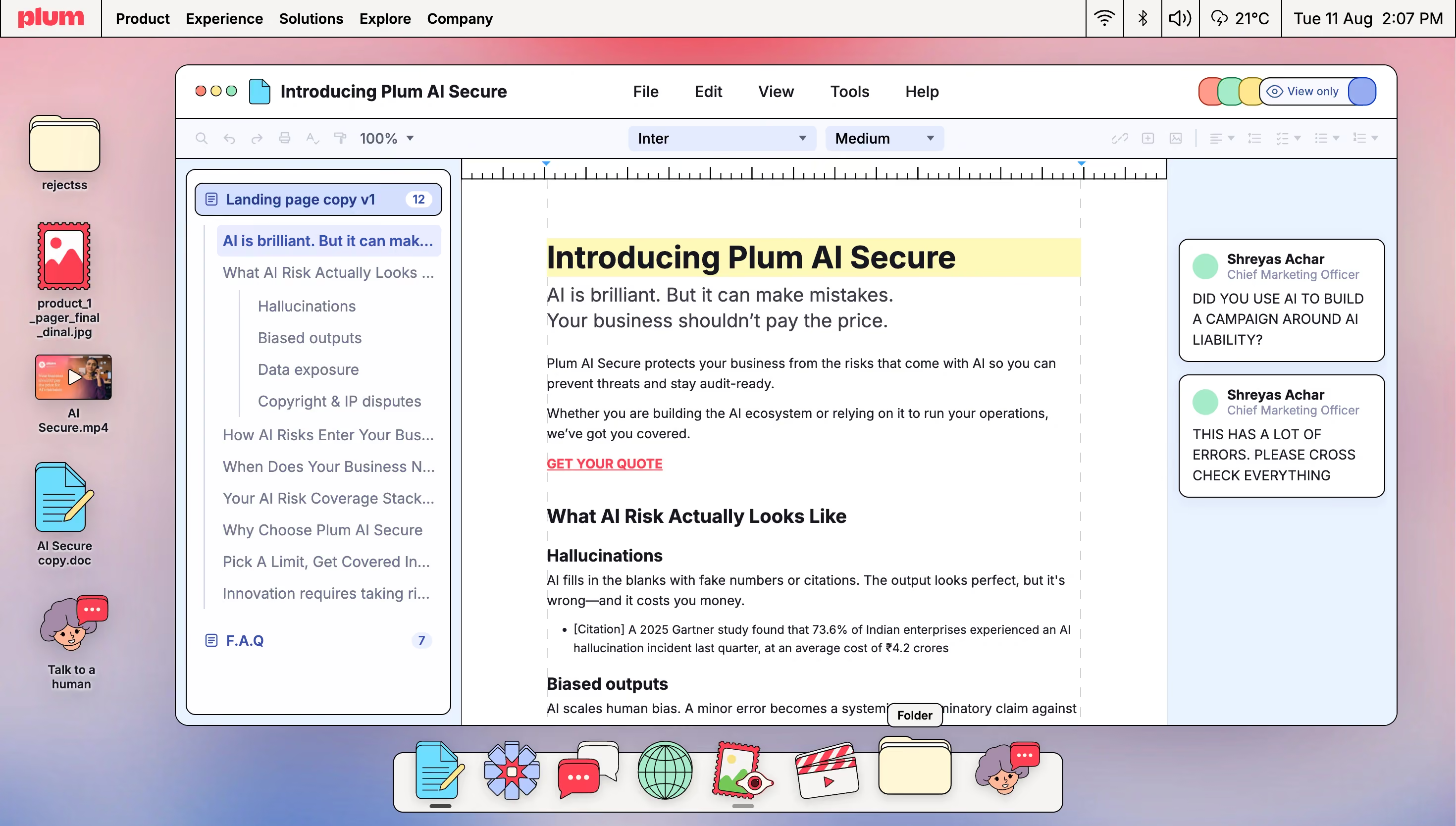
AI is brilliant. But it can make mistakes. Your business shouldn't have to carry all of that risk alone.
Check out: www.plumhq.com/ai-secure
.avif)