.avif)


.avif)

.avif)





.avif)


Ten years ago, if you were designing an employee health benefits plan for an Indian tech company, the picture in your head was reasonable. Employees came to the office five days a week and lived within an hour's commute of it, which meant they lived in a metro. Weekend health emergencies were within reach of a metro hospital, and the loneliness they felt on bad days was buffered by the colleagues they saw daily. The plan you designed around that picture worked well enough.
The workforce you were designing for barely exists anymore. What replaced it isn't only remote; it's remote and distributed, which are two different things pointing at the same shift. Remote means she doesn't come to the office. Distributed means she doesn't live near it. Both changes have consequences for the health benefits plan she now uses, and most plans have absorbed neither.
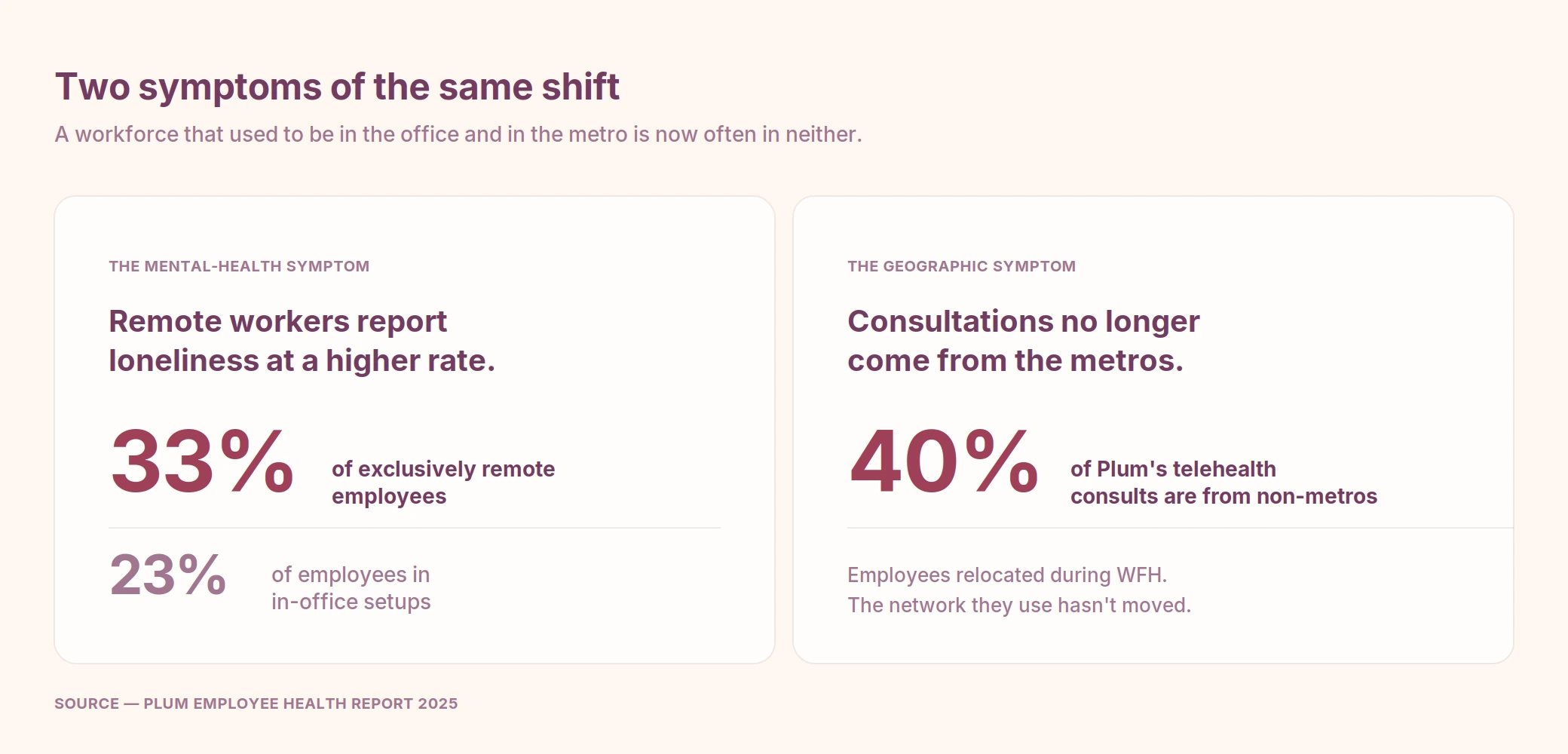
Take the mental-health picture first. Thirty-three per cent of exclusively remote employees on Plum's platform report feeling loneliness at work, compared with 23% of employees in in-office setups. Both numbers come from Plum's Employee Health Report 2025. The gap between them is not a lifestyle quibble. It is a base rate that means a materially higher share of your remote employees are moving through their working day with a health condition the benefits plan is supposed to address, and yet the pathway to address it, therapist access, is often bolted onto the plan rather than built into it.
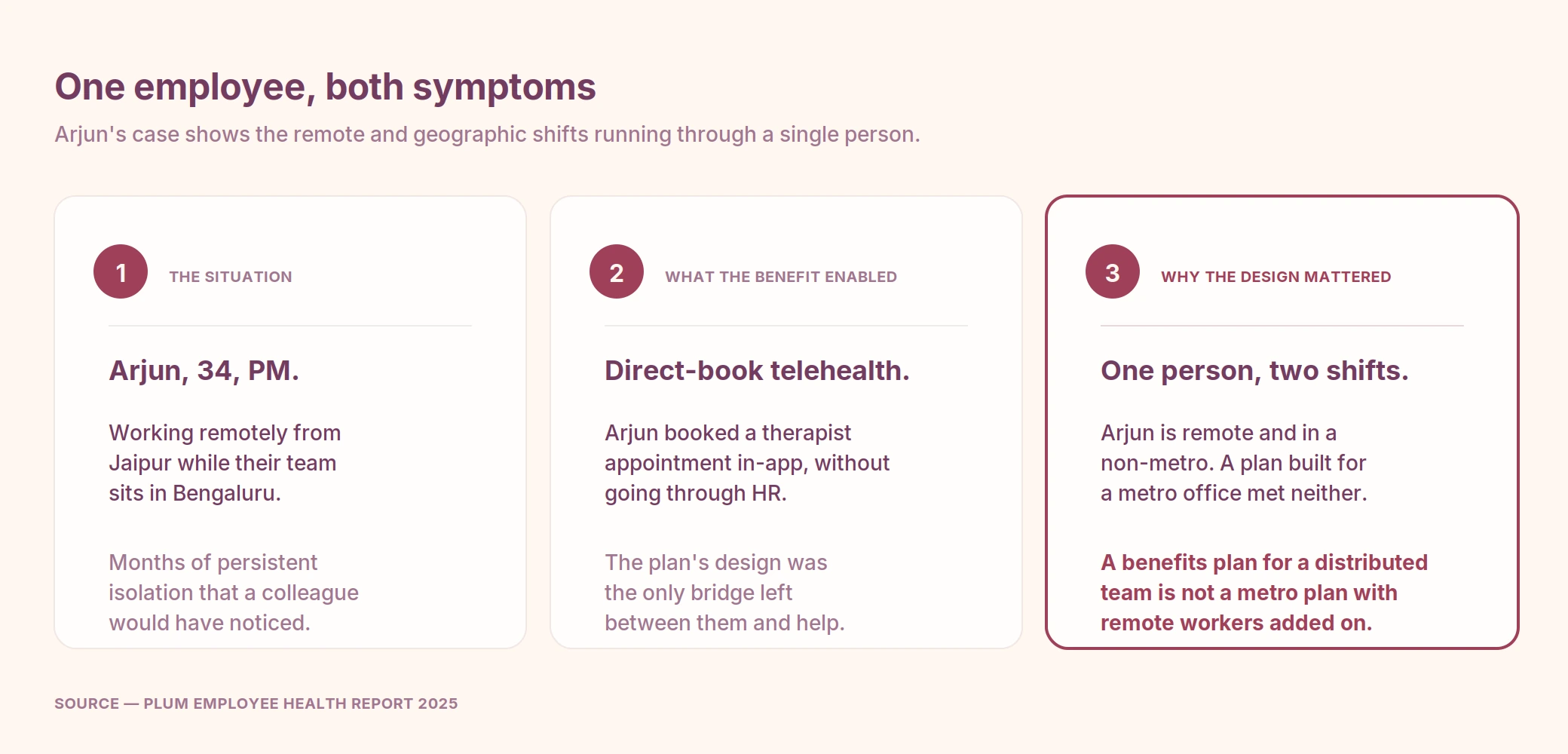
Arjun, whose case the report profiles, shows the shape this problem takes for a single employee. He is a 34-year-old product manager working remotely from Jaipur while his team sits in Bengaluru. After months of persistent isolation, he finally reached out for therapist support through his company's telehealth benefit. What made it possible was that he could book the appointment directly, without disclosing anything to HR or getting a manager's approval. In an in-office team, that friction would have been dissolved by a colleague noticing something off and asking about it. In Arjun's team, the plan's design was the only bridge.
The remote employee needs a different set of things from her benefits plan than the in-office employee does. Most Indian plans still supply the second set.
Arjun is also the shape the geographic half of the shift takes. He lives in Jaipur, not Bengaluru, and 40% of the telehealth consultations Plum's platform now sees come from employees like him in non-metro cities. This is a real redistribution, and it exposes a second design assumption most group health policies still carry: that when an employee needs a hospital, the hospital admitting her will be in the network the insurer built around metro cities. Most tier-2 cities in India have at least one good private hospital, so the assumption isn't entirely wrong. But the specialist mix and the network status of the hospitals employees now actually visit are meaningfully different from what a metro-based plan assumed. An employee working from Kanpur who needs an endocrinologist can see one via telehealth, which is a genuine gain. If she needs to be admitted for a procedure, her local network options are narrower than her plan's brochure suggests, and she may end up on a rushed trip to Delhi or Lucknow for something the network could have covered in her home city, had it been extended there.
From the benefits lead's chair, loneliness and network geography look like two different problems. They aren't. They are two visible symptoms of a workforce that has scattered while the plan stayed put. Both need the same underlying redesign: a plan that meets the employee where she now lives and works, rather than where the HQ still is.
A benefits plan for a distributed team is not a metro plan with remote workers added on. It is an entirely different plan.
What that redesign looks like isn't complicated conceptually. It involves two shifts, both addressing the same root. The first is telehealth built for the categories a distributed workforce actually presents at, which means mental health above all (because a third of remote employees are reporting loneliness that the plan has to answer), and family telehealth alongside it, because 37% of Plum's telehealth consultations are booked by an employee for a family member rather than herself, often a parent in a different city, as the Priya case from the report illustrates in detail. The second shift is a group-health network extended into the twenty or thirty non-metro cities where the workforce actually lives, rather than concentrated in the metros where the HQ still is. Neither shift is free, but neither requires rebuilding the plan from scratch.
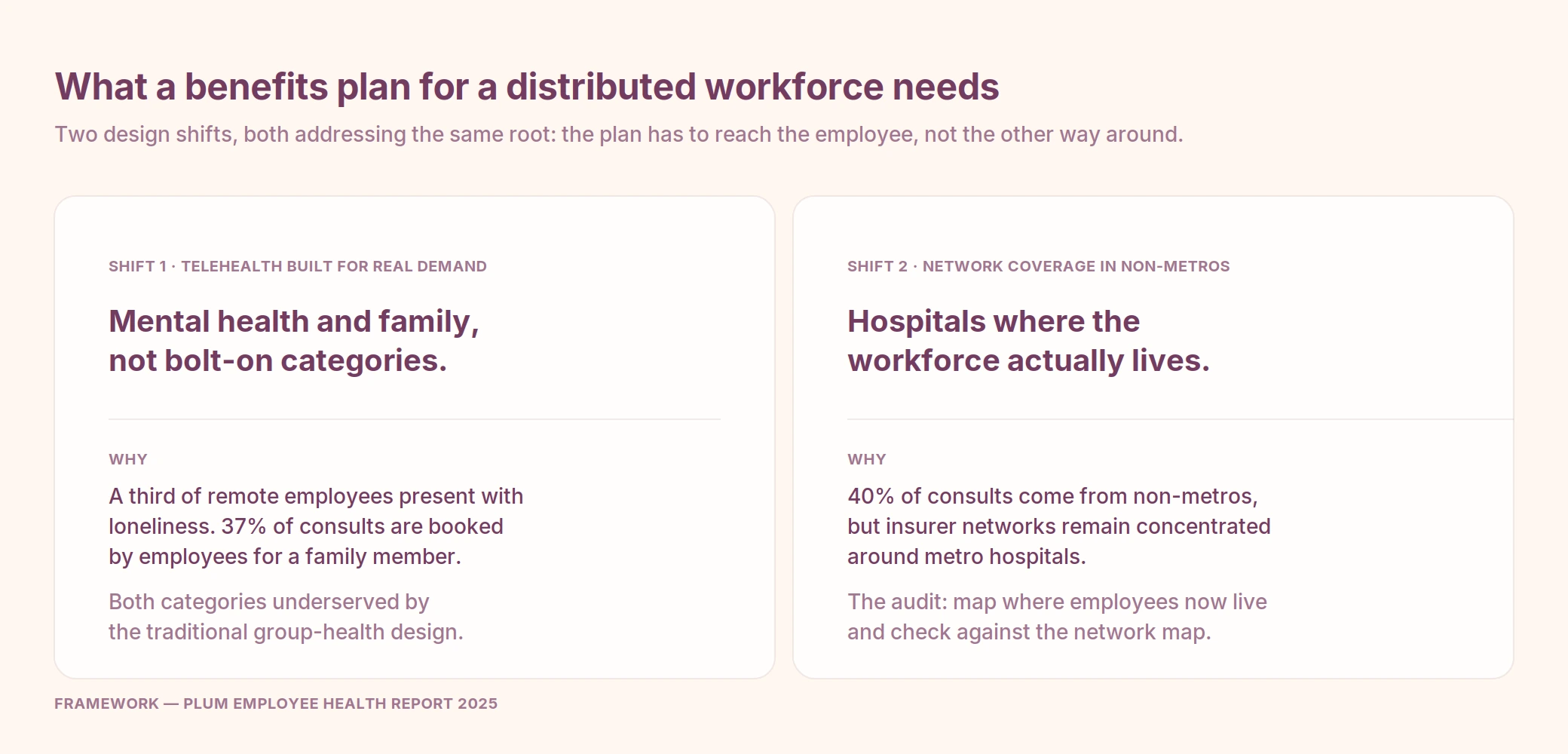
For a benefits lead whose workforce is meaningfully distributed, the first useful step is an audit against reality. Start with where your employees actually live rather than where your HQ is registered, and overlay that map against your insurer's network and the two categories above. Anywhere the map is empty is a place your plan is currently promising something it isn't equipped to deliver.
The plan you have was designed for the workforce you had when you signed the contract. That workforce has moved, to different cities and to different concerns. The plan should have moved with it. Most of what needs to change is a rewrite, not a rebuild.
Further reading
- Plum, Employee Health Report 2025 — the 33% remote vs 23% in-office loneliness split, the 40% non-metro consultation share, the 37% family-booking figure, and the Arjun and Priya anecdotes.