.avif)


.avif)

.avif)





.avif)


Debates about the length of the Indian work week have been unusually visible this past year. Public conversations about 70 and 90-hour weeks have put the question of work hours at the centre of corporate discourse in a way it hasn't been for a while. Sitting alongside that debate, though, is a second question the same data invites but which rarely gets asked with the same intensity. How many hours does an employee need to spend on her own health for the work hours, whatever their length, to be sustainable over time?
The context matters. According to figures cited in Plum's Employee Health Report 2025, the International Labour Organisation reports that 51% of the Indian workforce already spends more than 48 hours a week at work, which puts India near the top of the international overwork tables. The average Indian working week runs to 46 hours; the equivalent number in Germany is 33, in Australia 32, and in the United States 37. Add the commute, since 52% of Indian employees spend more than an hour a day getting to and from the office, and the average 48-hour week becomes an effective 55. India is not, on any credible reading of the data, an under-worked country.
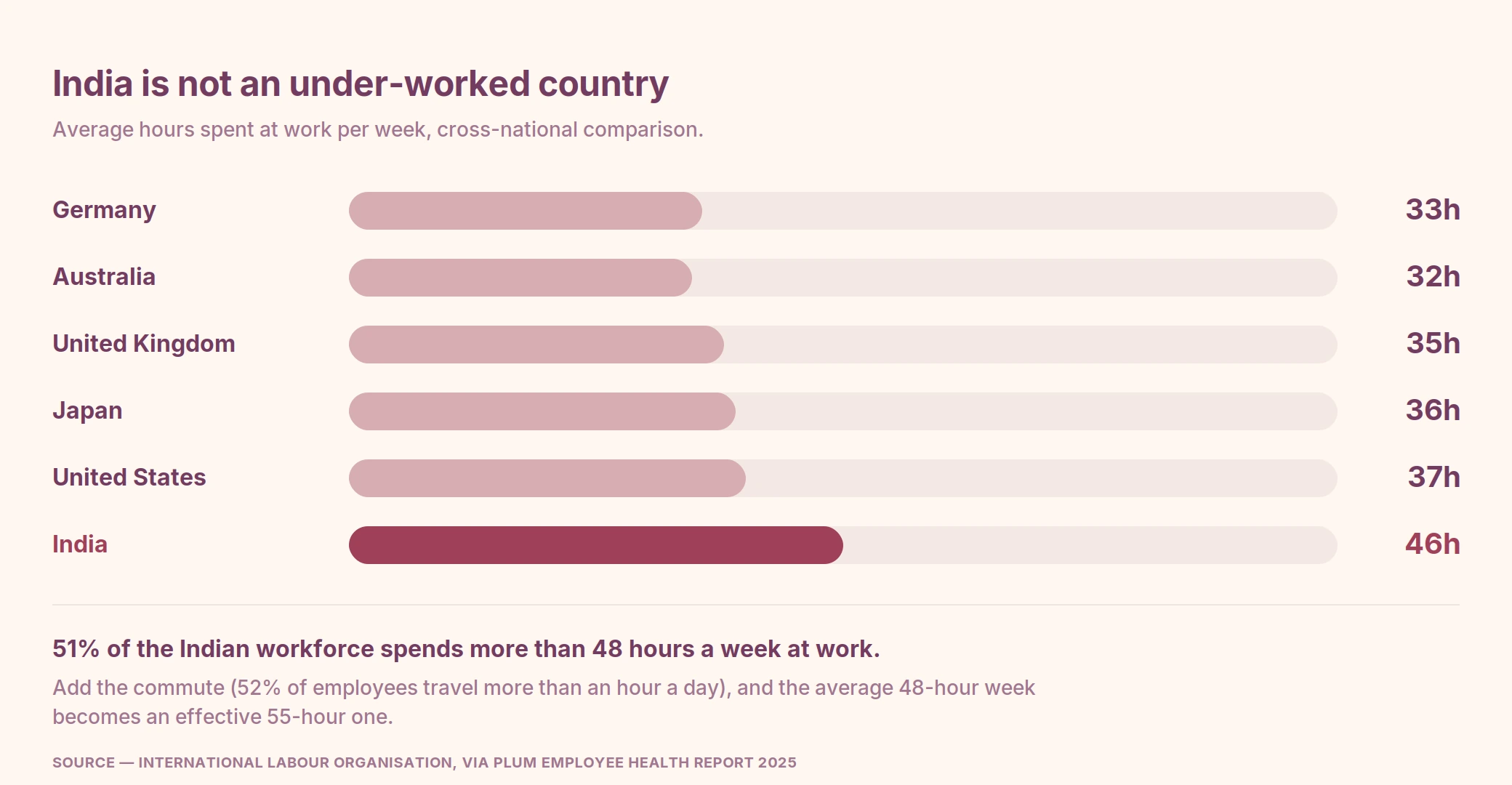
Any suggestion that the average Indian week should get longer, whatever the specific number, is a suggestion made about a country that is already near the top of the international overwork tables.
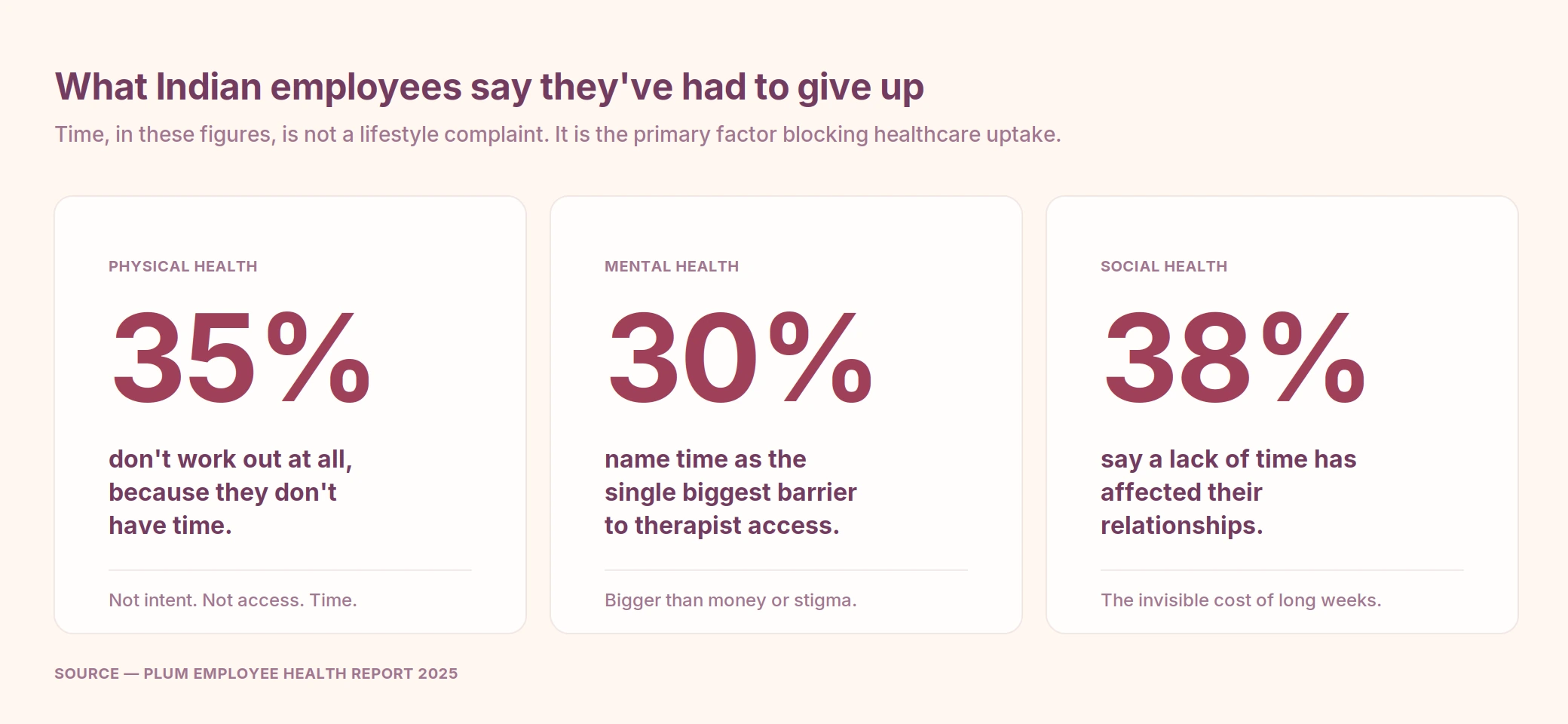
The consequences of that arithmetic show up most clearly in what employees say they can't do. Thirty-five per cent of Indian employees don't work out at all, because they don't have time. Thirty per cent name time as the single biggest barrier to accessing quality mental healthcare. Thirty-eight per cent say a lack of time has affected their relationships outside work. Time, in other words, is not a lifestyle complaint on the same footing as taste or motivation. It is the primary factor blocking the healthcare uptake that a benefits plan is designed to enable.
The 70-hour work week debate is arguing about a resource employees don't have. Most Indian employees are already choosing between an evening of exercise and an evening of sleep.
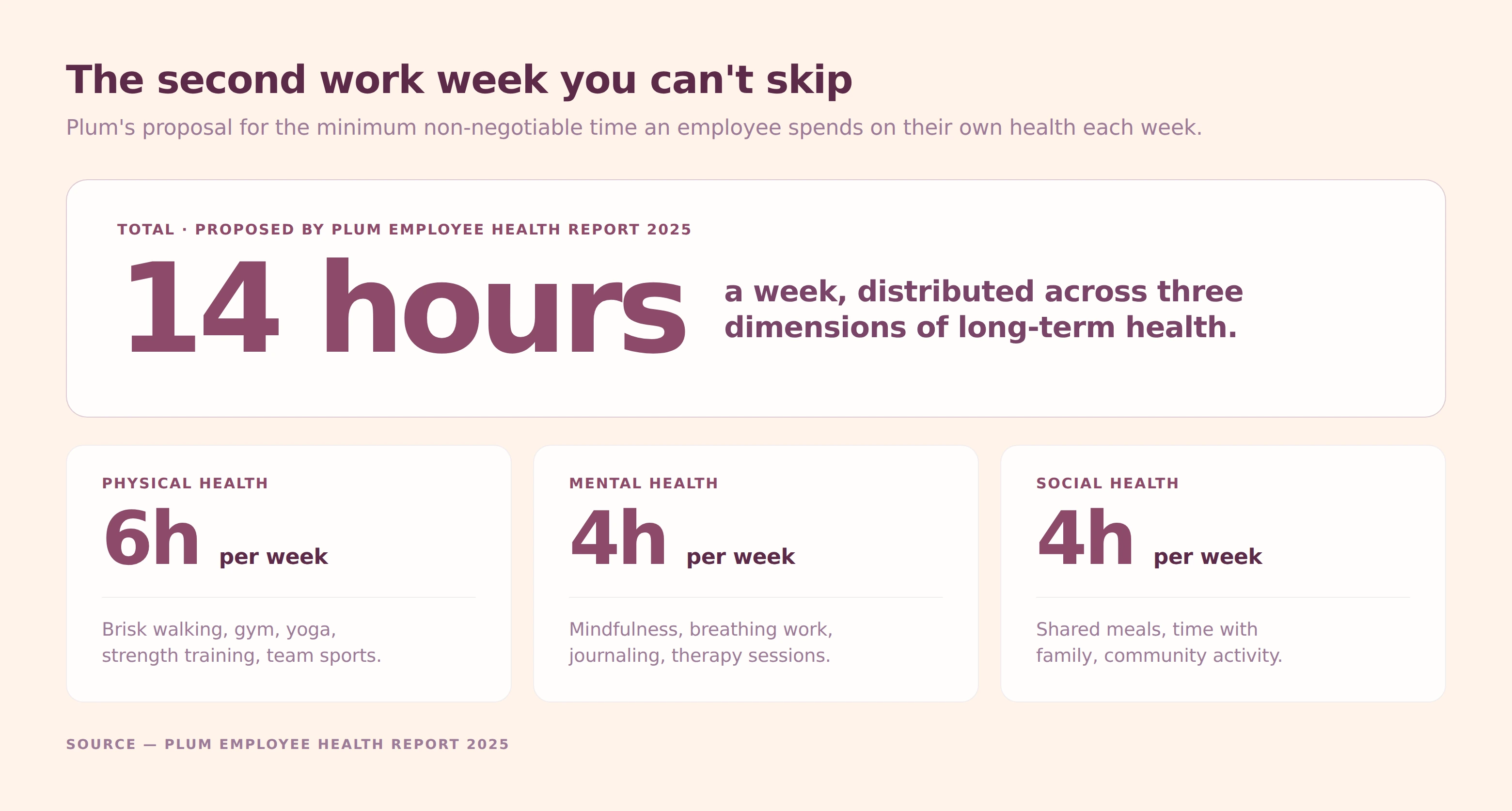
The Plum report proposes a specific counterweight. In addition to the work week, employees need what it calls a 14-hour health week: two hours a day, seven days, distributed across the dimensions that determine long-term health. The breakdown is roughly six hours a week on physical health (brisk walking, gym or strength training, yoga, team sports), four hours on mental health (mindfulness, breathing exercises, journaling, therapy sessions), and four hours on social health (shared meals with colleagues, time with family, community or volunteering activity). None of this is exotic. All of it is what the WHO and every credible longevity researcher has been recommending for decades. What the report adds is the number and the framing. The 14 hours are a second work week, and skipping them has a cost the employee will pay in claims and absenteeism five years later.
The reason this framing matters for HR is that it flips the question the industry has been asking. The debate about work hours treats the employee as the person who has to make the trade-off: whether to prioritise the gym or the deadline, whether to book therapy or push it another week. The 14-hour health week reframes it as an operational question. If employees genuinely need those 14 hours, and the data suggests they do, then HR's job is to help teams protect them, in the same way HR helps teams protect focus time or annual leave.
The 14-hour week isn't just a wellness perk. It's a requirement for overall operations.
What that looks like in practice is unglamorous. Calendar-level protection of health time is a starting point. Many companies now block "no meetings before 10 am" or "no meetings after 6 pm" windows, which sound trivial but function as HR-sanctioned permission for employees to build routines around them. Flexibility around when the 14 hours get taken matters more than requiring specific slots; some employees will run at 6 am, others at 8 pm, and some will schedule therapy during a lunch hour. Providing paid, non-stigmatised access to therapy that can be booked during work hours does more for the mental-health portion of the 14 hours than a resilience workshop ever will. And reducing the internal meeting burden that eats into the working day, one of the most direct interventions available, gives employees the actual hours they need to redistribute.
The other thing HR can do, and the one most companies still resist, is set expectations at the manager level. A team lead who insists on 10 pm calls is, in effect, taxing his team's 14-hour health week to fund his own delivery timeline. A team lead who defends his team's evenings is not being soft; he is protecting an operational input. Most companies handle this asymmetrically, celebrating the first behaviour and calling the second one a "culture question." It isn't. It's a resource-allocation question, and the resource being allocated is employee health.
For a founder or benefits lead reading this, the useful thing to do is not to launch a wellness campaign. It is to ask a different question at the next planning cycle. Not how much are you spending on the group health policy, but how much of the working week are you actually leaving employees free to spend on their health. If the answer is significantly less than the 14 hours the report suggests they need, the group health policy will keep paying for the consequences.
The 70-hour and 90-hour debate has been the loudest health conversation in Indian corporate life for the past year. It has also been arguing about the wrong number. The one to fix is not the ceiling on the work week but the floor on the health week the work week is currently eating into.
Further reading
- Plum, Employee Health Report 2025 — the ILO 48-hour overwork figure, the 46-vs-32-to-37-hour international comparison, the 35% exercise-skip, 30% mental-healthcare-time-barrier and 38% relationship-time figures, and the full 14-hour health week proposal with the physical, mental and social breakdown.