.avif)


.avif)

.avif)





.avif)


Somewhere on the internal HR portal of a Bengaluru product company right now, an employee is entering the name of the person she considers her partner into a field labelled "dependent." That person is not her spouse in any way the state currently recognises. Depending on the year of the entry and the company running the portal, she may be entering the name against a category the portal itself only added in the last two annual policy cycles. The portal is not asking her whether she is married. It is asking her, in effect, who her family is.
Multiply that entry across the roughly forty per cent of employees at flex-enabled Indian companies who now choose dependents that don't fit the traditional employee-spouse-child shape, and something new comes into view. Insurance policies have become a live census of what the Indian family looks like right now, and the census is being written faster inside HR portals than anywhere else in the country.
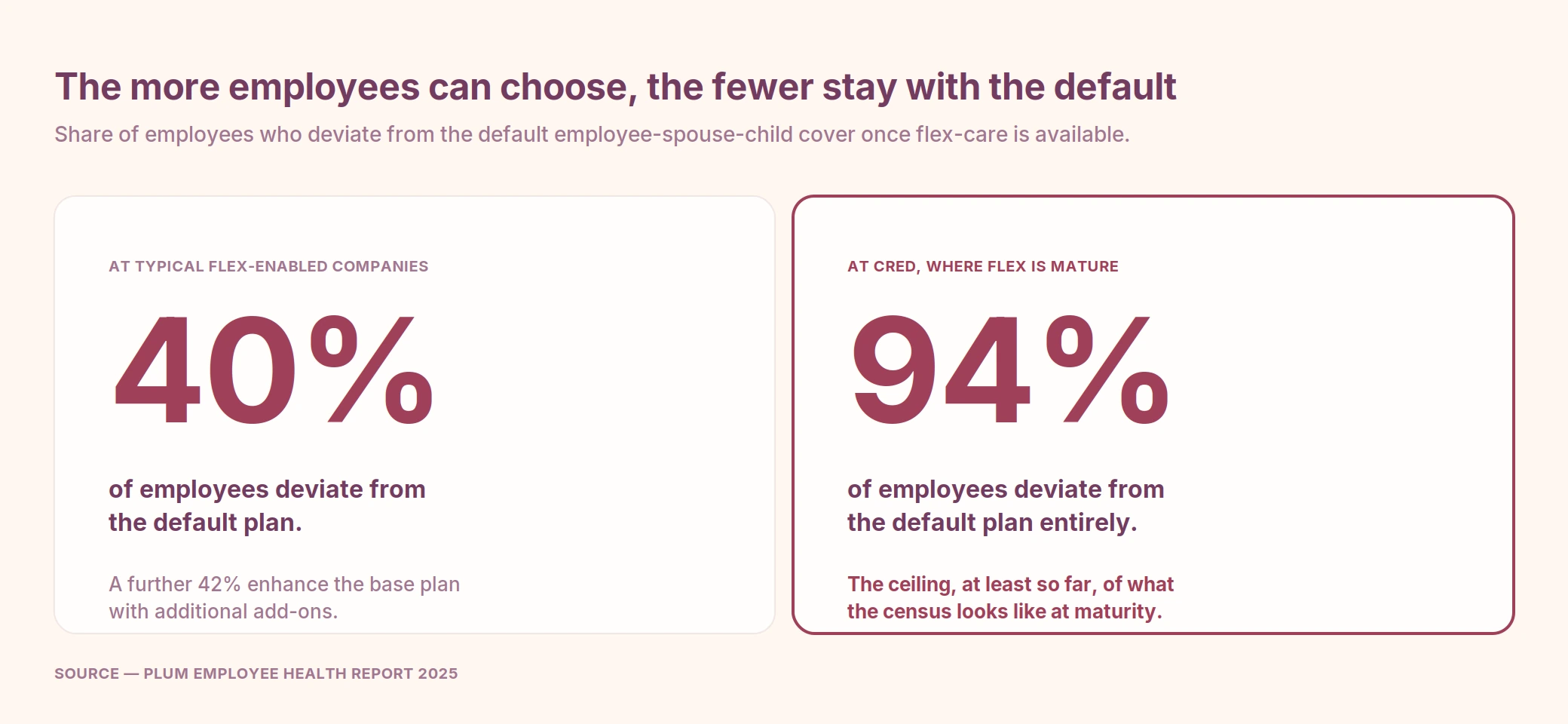
Plum's Employee Health Report 2025 has the numbers. Around 40% of enterprise companies partnering with Plum have moved to some version of flex-care, a plan design in which the employee, within a per-employee budget the company already sets, chooses who to cover and which add-ons matter to her. Within those flex-enabled companies, 40% of employees now deviate from the default employee-spouse-child cover, and 42% enhance the base policy with additional add-ons. At CRED, where flex adoption is more mature, 94% of employees deviate from the default plan entirely, and use flex to build their own coverage.
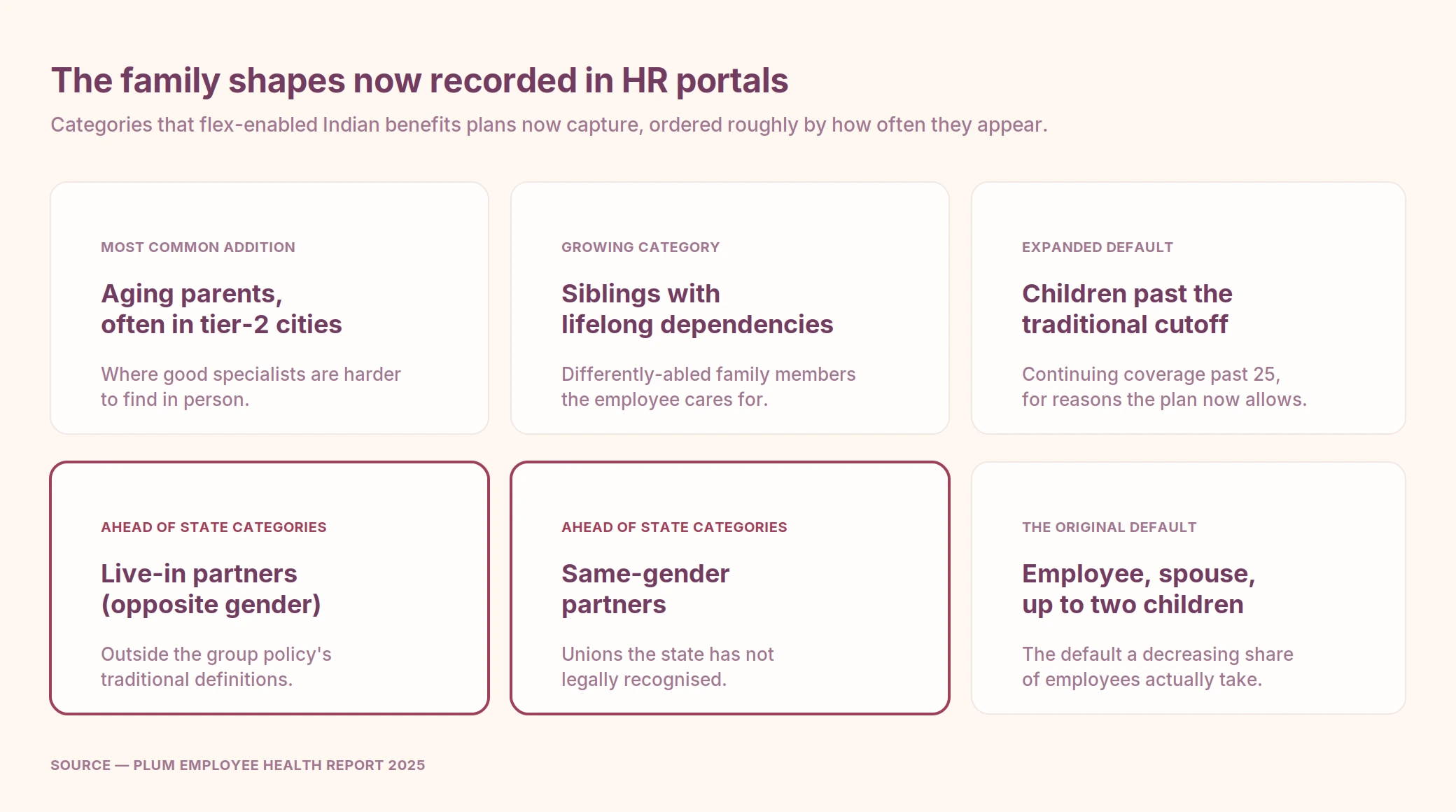
The categories those employees are choosing tell a specific story. Parents are the most common addition, especially aging parents in smaller cities where good specialists are harder to find. Siblings with lifelong dependencies come next, alongside children who need continuing coverage well past the traditional cutoff of 25 for reasons the group policy didn't previously accommodate. Further down the list, but growing every year, sit the categories that most conspicuously deviate from the family shape older policies assumed. Live-in partners of the opposite gender, whose relationships fall outside the frame of the group policy's default definitions. Same-gender partners, whose unions the Indian state has declined to recognise but who nonetheless share homes and financial lives.
Corporate insurance policies have become one of the most honest records available of who Indians actually consider family, and the state has not caught up.
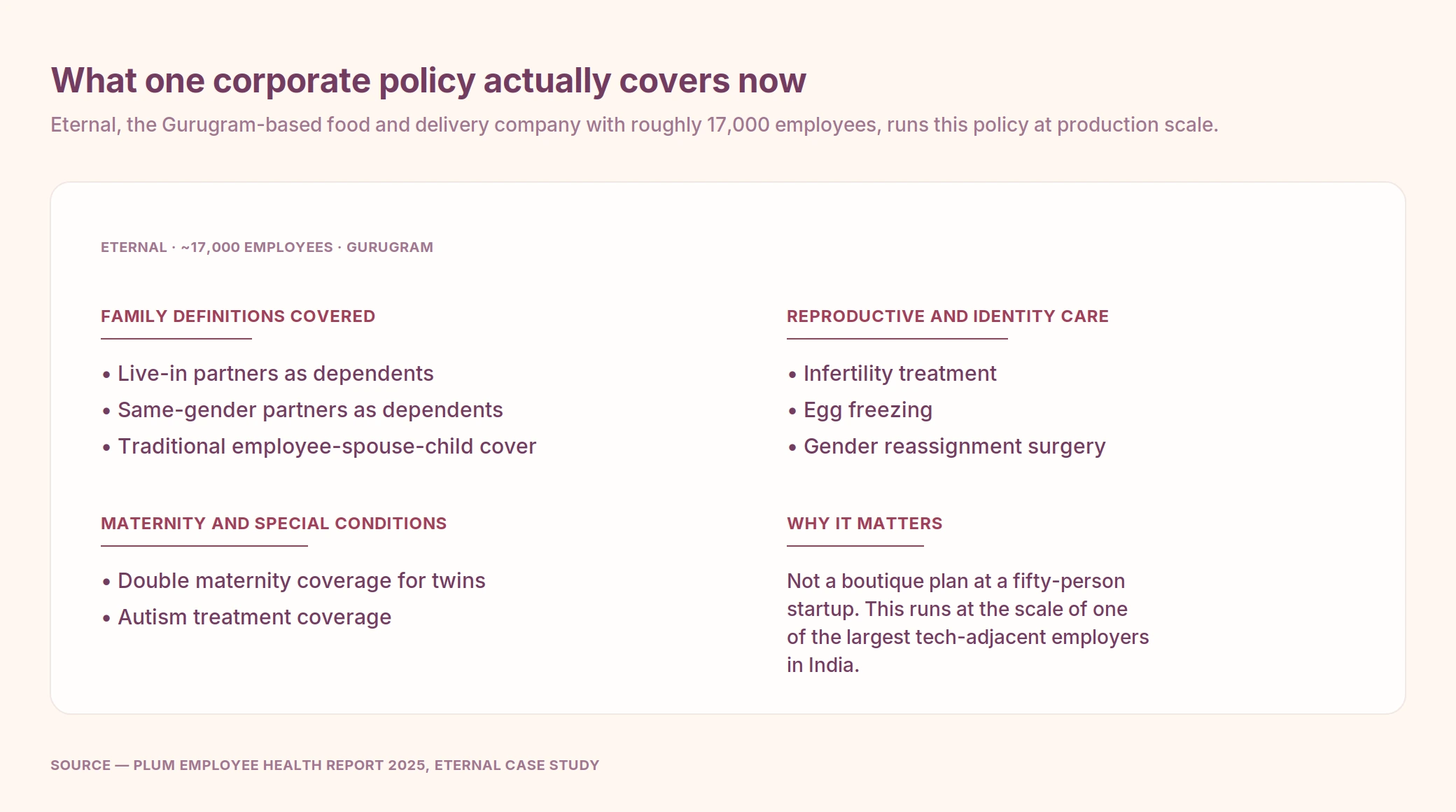
The clearest examples of this shift come from companies that have been explicit about it. Eternal, the Gurugram-based food and delivery company with roughly 17,000 employees, runs a medical insurance policy that covers live-in and same-gender partners as dependents. The same policy funds infertility treatment and egg-freezing, and it includes gender reassignment surgery. It provides double maternity coverage in the case of twins, and coverage for autism treatment. This is not a boutique benefits programme built for a fifty-person startup. It is the corporate healthcare plan of one of the largest tech-adjacent employers in India, running at production scale.
The reason this reshaping is happening in HR portals ahead of civic categories is structural. An employer, at some point in the year, has to sit down with a benefits provider and answer a set of operational questions about its workforce. How many people will the policy cover per employee? What mix of dependents should it plan for? What is the average sum insured a family of this shape will need? To answer any of those questions, the employer has to ask employees who their family is. And the answer employees give is not filtered through the categories the state has approved. It is filtered through the categories the employee's life actually contains.
The state, by contrast, has both cultural and political constraints on how quickly it can update. Marriage law in India moves slowly. The Supreme Court, in 2023, declined to legalise same-sex marriage, leaving that question to Parliament. Legal recognition of live-in relationships remains partial and contested. Neither of those slow-moving debates prevents an HR system at Eternal or CRED from listing a same-gender partner as a dependent on a health policy, and the health policy in turn creates a set of documented facts, from claims records to hospital admissions, that establish a reality on the ground independent of the debate the courts are having.
HR portals are where the Indian family is being redefined ahead of the official categories, because HR portals cannot afford to wait for the definitions to be officially updated.
The design pattern that lets this reshaping happen is flex-care. In a traditional plan, HR designs the coverage and the employee accepts it. Every employee gets the same shape of policy: employee, spouse, up to two children, sometimes parents as an add-on. This works when the underlying employee population is homogenous. It doesn't work when a meaningful portion of that population has a family that doesn't fit the shape. Flex-care hands the shape decision to the employee. She uses her allocation to add her aging mother in Kottayam, or she adds her live-in partner, or she adds her differently-abled sibling. The employer's budget is the same. The category the employer captures on the census is completely different.
For HR leaders whose plans still use the default employee-spouse-child structure, there is a specific lesson in the 40% deviation figure. It is unlikely to be unique to flex-enabled companies. It is much more likely to reflect the true underlying shape of the Indian workforce, currently hidden by policies that don't let employees declare it. If your plan doesn't let a same-gender partner be added as a dependent, you are not learning that no employee has one. You are learning that no employee thinks it's worth asking for.
The other implication is subtler. The corporate insurance policy has, in the past five years, become an unlikely site of civic infrastructure in India. It is where the Indian family is being counted and recognised at operational scale, without waiting for the categories to be blessed elsewhere. Whether the state eventually catches up is a separate question. The census, in the meantime, is being written every day inside HR portals, one dependent field at a time.
Further reading
- Plum, Employee Health Report 2025 — the 40% flex-care enterprise adoption figure, the 40% employee-deviation figure, the 42% add-on figure, and the detailed case studies of Eternal, CRED, and Meesho.
- Plum, The State of Employee Benefits 2024 — the flex-care design pattern and the illustrative case of Arjun, Reema, and Alex.