.avif)


.avif)

.avif)





.avif)


You won't find it on the calendar. Nobody in HR scheduled it. But the group that gathers by the back gate every couple of hours (a couple of engineers, someone from finance, one of the founders, occasionally the office manager) is having the closest thing your company still has to a genuinely cross-functional conversation. And it holds a lesson for the offices and hybrid setups that no longer have back gates at all.
21% of Indian employees smoke at least one cigarette a week, per Plum's Employee Health Report 2025. That figure alone tells you the smoke break is a real fixture in most Indian workplaces, not an edge case. The more useful thing about the smoking corner, though, isn't the smoking. It's the set of design principles hiding underneath it, and how few of them survive when HR tries to recreate the same social outcome deliberately.
Consider what actually happens at the smoking corner. A junior developer gets a five-minute window with a founder they'd otherwise have to schedule two weeks out. A CFO hears a piece of gossip from operations that would never have made it into a status meeting. Two teams that don't share Slack channels swap notes on a client who's gone unusually silent. In most Indian offices, the smoking corner is one of the last remaining spaces where hierarchy briefly flattens and unofficial information moves freely. It is, whether HR would ever describe it that way, a cross-functional contact zone.
The design principle isn't about smoking. It's about giving employees a reason to be somewhere that has nothing to do with work.
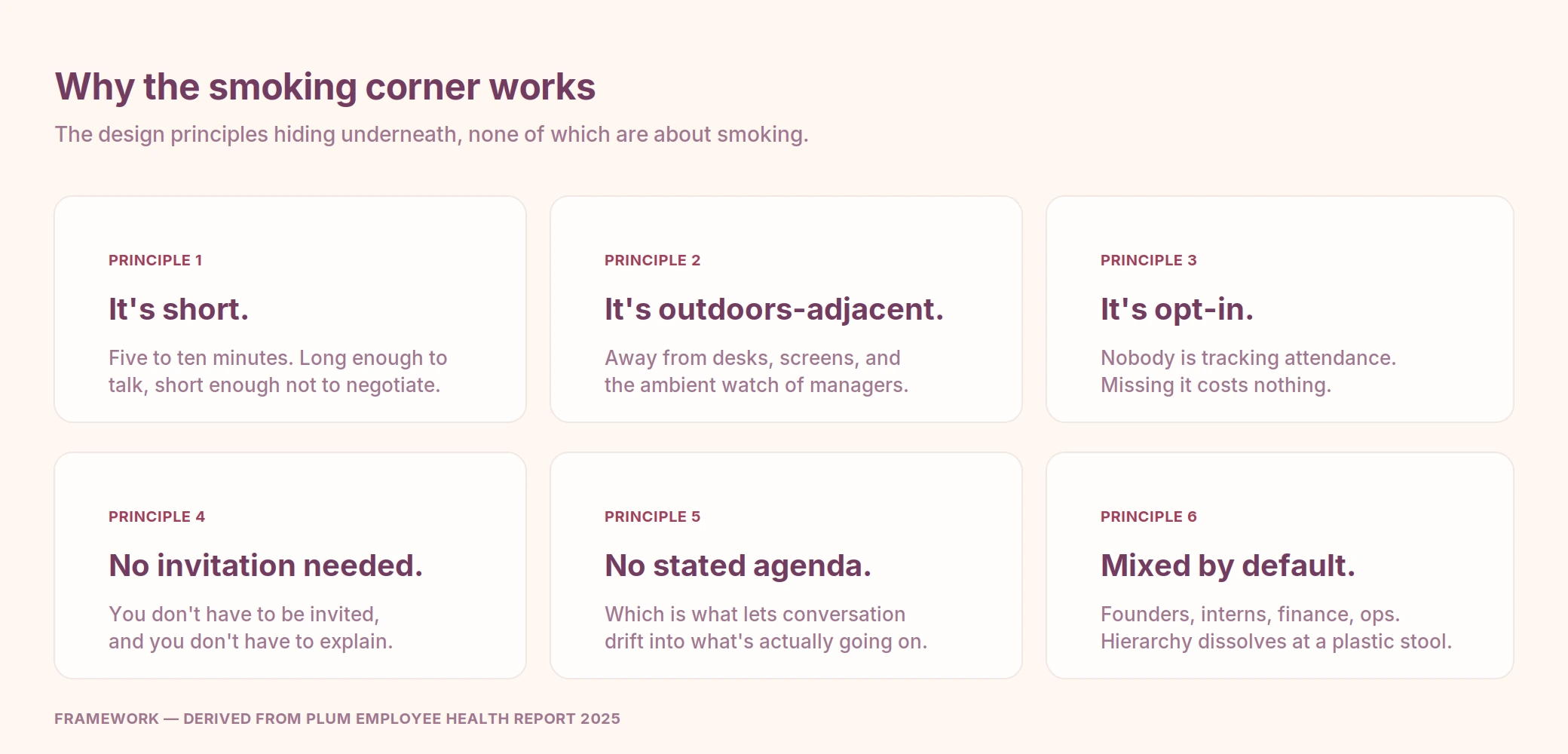
The design principles are easy to name once you look for them. The smoke break is short. It's outdoors or outdoors-adjacent. It requires no invitation, no calendar block. It's opt-in and easy to skip. Hierarchy dissolves because the physical setup (standing around a plastic stool or a metal railing) makes it hard to preserve. And crucially, the ostensible reason for being there has nothing to do with work, which is exactly what gives the conversation permission to drift into things nobody would raise in a meeting.
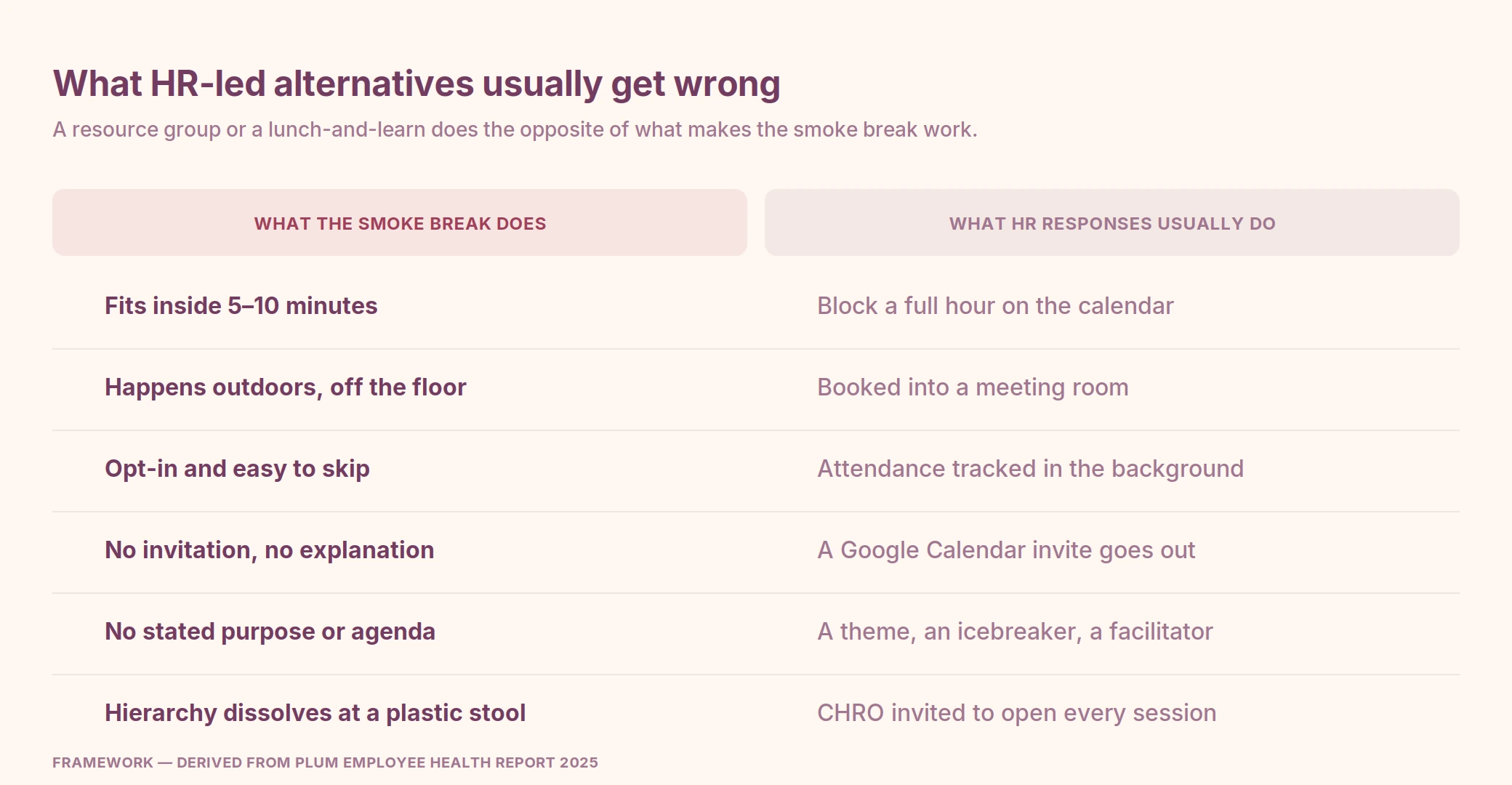
None of these are things HR-led alternatives usually preserve. The typical response to "we need more cross-team connection" is a resource group or a lunch-and-learn with a badge on someone's LinkedIn profile. Both do the opposite of what the smoking corner does. They're scheduled, they're indoors, they require an invitation, they have a stated agenda, and they announce themselves as cross-functional exercises, which is precisely the thing that kills unstructured conversation.
The offices that have gotten this right tend to lean into physical and temporal design rather than programme design. A chai stall or tapri outside the building, subsidised for a fixed daily window, does most of the smoking corner's work without asking anyone to explain their presence. So does an unlocked terrace or balcony, which most Indian offices technically have and most keep locked for insurance reasons. Coffee machines placed slightly-in-the-way rather than tucked into service corridors, so that people walking past them pause. A four o'clock chai break that isn't organised but is protected in the calendar. The physics is the same: outdoor-adjacent, brief, unstructured, walk-past-able.
For companies with distributed or hybrid teams, the physical layout options run out quickly, and the design problem shifts. The version that scales best across a distributed workforce is what companies are starting to call micro-communities: small, self-selected groups that meet on their own terms around something specific, without HR designing the agenda. A running group that meets Saturday morning at Cubbon Park. A film club that watches something together and argues about it on Slack the next day. A group of parents in the company who share a WhatsApp thread about paediatricians. A cycling group. A book club.
None of these look, on paper, like a workplace-connection initiative, which is precisely why they work. They give employees a reason to talk to colleagues they wouldn't otherwise meet, on subjects that aren't work, in windows the calendar doesn't own. HR's job here is smaller than usual and harder to do well: seed the first two or three groups, cover the incidental costs, and step back. The instinct to formalise them as "employee resource groups" and invite the CHRO to open every session is exactly what kills them.
The smoking corner works because nobody was in charge. A good micro-community works for the same reason.
There are five practical shifts most HR teams could make this quarter that would meaningfully improve cross-functional contact without spending on any new programme:
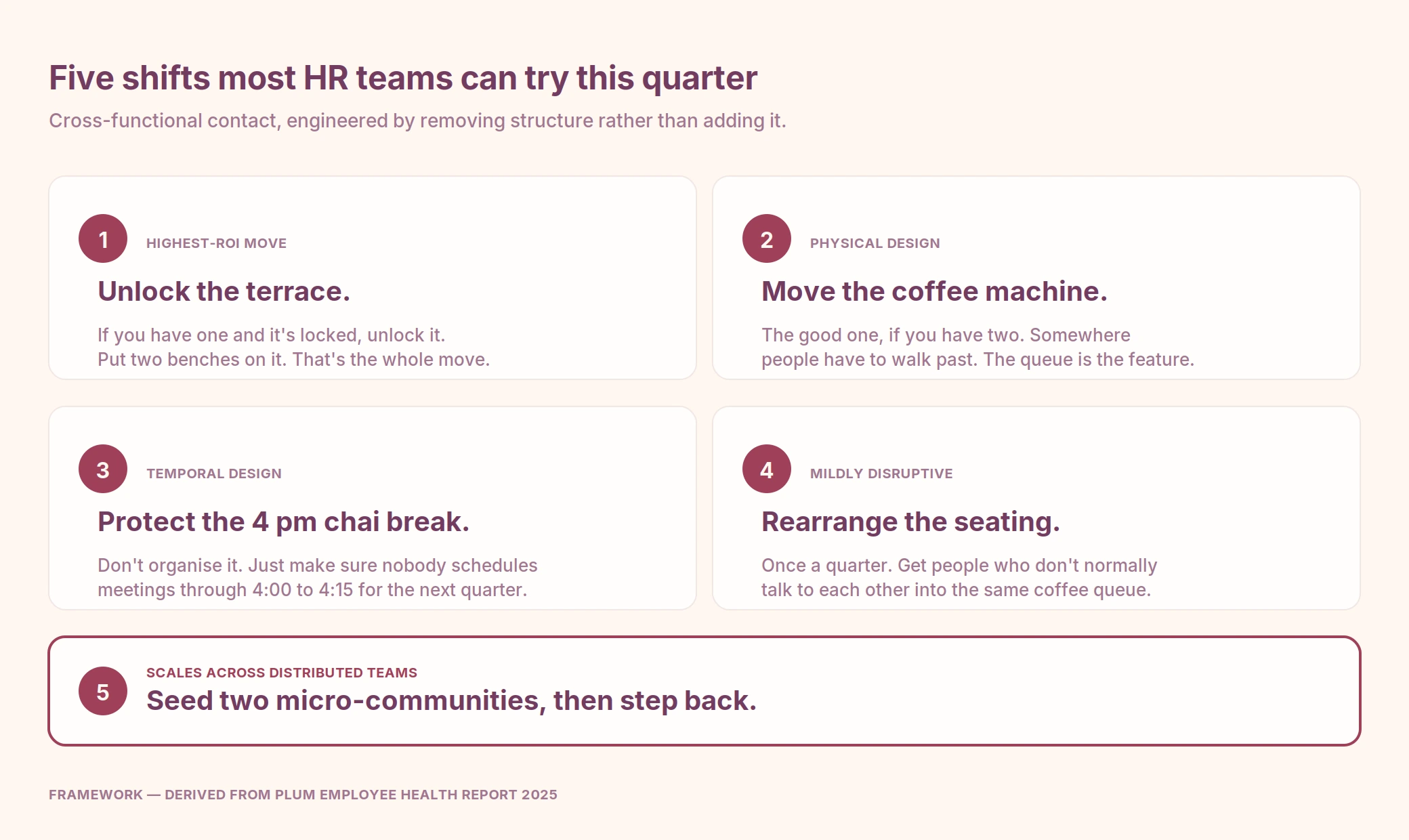
Unlock the terrace. If your office has one and it's locked, unlock it. Put two benches on it. The single highest-ROI move on this list.
Move the coffee machine. The good one, if you have two. Put it somewhere people have to walk past, near a window or a wall. The queue is the feature.
Protect the 4 pm chai break. Don't organise it. Just make sure no meetings get scheduled through 4:00 to 4:15 for the next quarter, and let the ritual re-establish itself.
Rearrange the seating. Once a quarter, move different teams next to each other. It's mildly disruptive and universally complained about for the first week, and it's the single most reliable way to get people who don't normally talk to each other into the same coffee queue.
Seed two micro-communities, then step back. A running group and a book club will get you further than a formal engagement initiative. Cover the incidental cost, resist the urge to badge them, and let them run themselves.
What these have in common with the smoke break is a set of design constraints most HR-led attempts miss: brief, opt-in, outdoors-adjacent when possible, no stated agenda, mixed-hierarchy by default, no invitation required. Nothing on the list is expensive. Nothing on the list has a KPI attached. Every item works because it removes structure rather than adds it.
The temptation, once you notice how much cross-functional work the smoking corner is doing, is to try to recreate it inside a programme with a name and a budget and a quarterly readout. That instinct is exactly what needs resisting. The smoking corner became what it is precisely because HR never noticed it existed, and any replacement will need to inherit the same invisibility.
The smoking corner will still be there next quarter, and it will still be doing more cross-functional work than most offsites do in a year. The interesting question is not how to compete with it. It's what else you can build that runs on the same principles.
Further reading
- Plum, Employee Health Report 2025 — the 21% weekly-smoker figure among Indian employees, plus broader data on workplace connection and cross-functional collaboration patterns.