.avif)


.avif)

.avif)







.avif)


What is the full form of PIP?
The full form of PIP in HR is Performance Improvement Plan.
A Performance Improvement Plan is a formal, written document that identifies specific gaps in an employee's performance, defines what acceptable performance looks like, and gives the employee a fixed window of time (usually 30, 60, or 90 days) to close the gap with structured support from their manager and HR.
If you're a new HR Business Partner, you will be involved in PIPs more often than almost any other type of employee relations case. This guide explains what a PIP actually is, when one is appropriate, how to write a defensible plan, what your role looks like as the HRBP, and the mistakes that turn a well-intended plan into a legal or cultural problem.
What does PIP stand for outside of HR?
"PIP" is an acronym used in several fields. If someone in your organisation uses the term and the context isn't obvious, here is what they could mean:
In an HR context, PIP almost always means Performance Improvement Plan, and that is the meaning we use throughout this article.
What a Performance Improvement Plan actually is
A PIP is a structured document that does four things:
- States, with specific examples and evidence, where an employee's performance is falling short of the standard for their role.
- Defines the performance standard the employee is expected to reach, in measurable terms.
- Lists the support, training, and resources the company will provide.
- Sets a review date and explains what happens if the employee meets the goals, and what happens if they don't.
It is not a warning letter, and it is not the same as a disciplinary action. A warning tells someone they have a problem. A PIP gives them a written roadmap to fix it, with checkpoints and resources attached. Disciplinary action is reserved for misconduct (theft, harassment, policy violations) and follows a different process.
A PIP is also not, by itself, a termination notice. Many employees do recover from a PIP. The reason PIPs have such a poor reputation is that some managers misuse them as documentation to support a decision they have already made, rather than as a genuine attempt to retain the employee. Part of your job as an HRBP is to push back when that's happening.
When a PIP is appropriate, and when it isn't
Use a PIP when all of the following are true:
- The performance gap is real, documented, and has been raised with the employee already through informal feedback or coaching.
- The gap relates to ability or skill, not unwillingness or misconduct. Skill issues can be coached. Misconduct goes through the disciplinary process instead.
- The gap is something the employee can plausibly close in 30 to 90 days with the right support.
- The expectations the employee is failing to meet were communicated clearly, in writing, before the PIP was drafted.
A PIP is the wrong tool when:
- The employee has never been told their performance is a problem. A PIP should be the formal continuation of an existing conversation, not the start of one.
- The manager wants to skip a difficult conversation by hiding behind a document.
- The real issue is a personality clash, a reorganisation, or a manager who hasn't given clear direction.
- The role itself has changed and the employee hasn't been retrained.
- The employee is on protected leave, has recently raised a complaint, or has disclosed a disability that hasn't been accommodated. In these cases, talk to legal before issuing anything.
If a manager comes to you wanting to "PIP someone out," that is a red flag. The PIP is a tool to improve performance, and using it as a pre-packaged exit creates legal exposure and damages team trust.
How long should a PIP last?
Most PIPs run 30, 60, or 90 days. Anything shorter than 30 days doesn't give the employee a fair chance to demonstrate sustained improvement. Anything longer than 90 days tends to drag, lose focus, and make people think they can procrastinate.
Match the length to the issue:
- 30 days works for clear, measurable issues such as missing a defined sales quota, attendance, or simple deliverable timelines.
- 60 days is the middle ground for mixed quantitative and qualitative gaps.
- 90 days is appropriate when the employee needs to learn a new system, develop a leadership behaviour, or demonstrate a pattern of improved judgment over time.
Build in checkpoint meetings. A weekly or bi-weekly check-in with the manager, plus a mid-point review with HR present, is standard. Don't wait until the final day of the PIP to find out whether it worked.
What goes inside a PIP document
A defensible PIP contains, at minimum, the following sections:
1. Employee and manager information Name, role, manager, HRBP, start date and end date of the plan.
2. Background and context A brief, factual summary of the performance issues, including the dates and content of prior coaching conversations. Avoid emotional language. Stick to what was said, what was done, and what was observed.
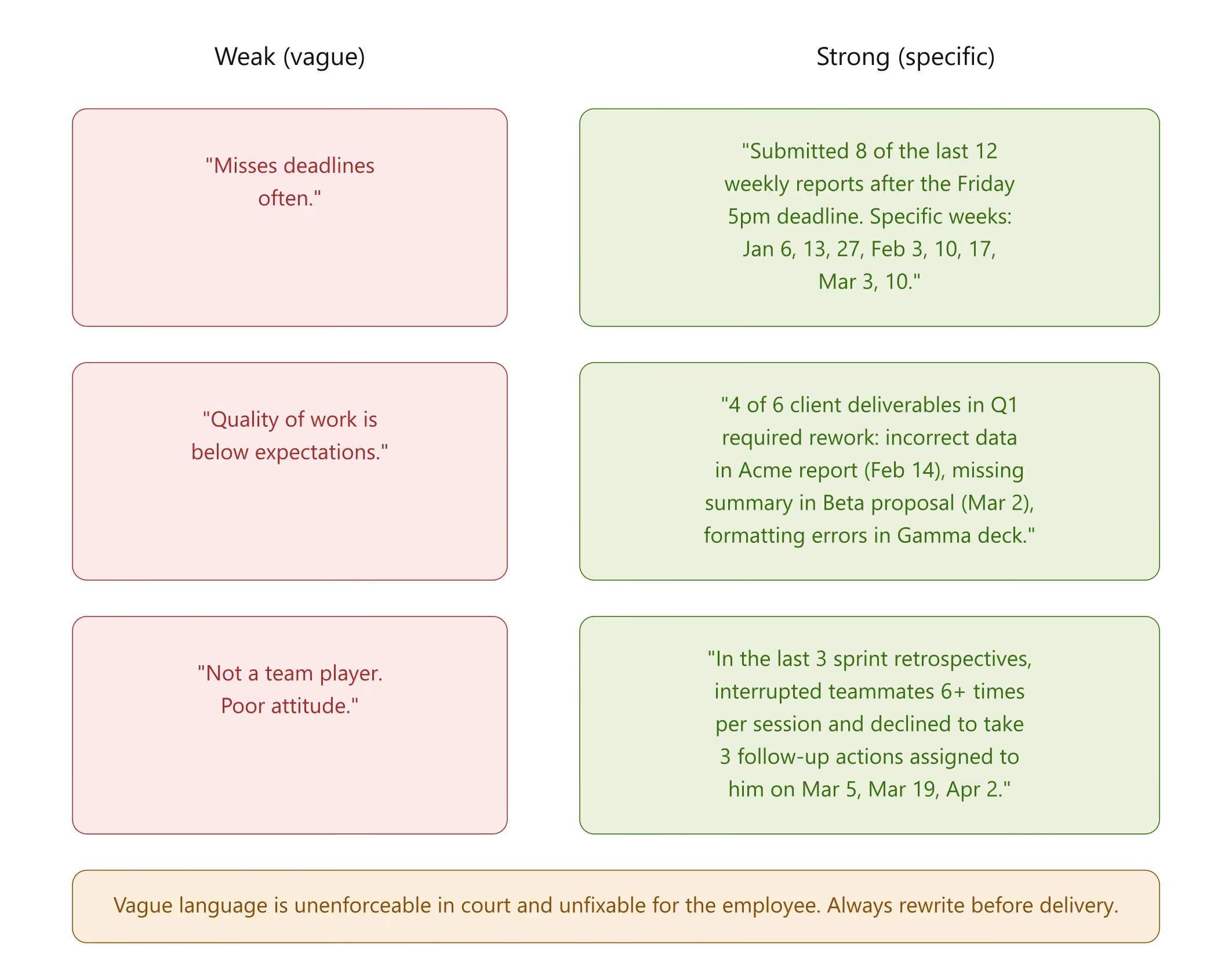
3. Specific performance gaps This is where most weak PIPs fail. Generic phrases like "poor attitude," "lack of ownership," or "not a team player" are not actionable and are difficult to defend. Replace them with specific, evidenced statements:
- Weak: "Misses deadlines often."
- Strong: "Submitted 8 of the last 12 weekly reports after the Friday 5pm deadline (specifically: weeks of Jan 6, Jan 13, Jan 27, Feb 3, Feb 10, Feb 17, Mar 3, Mar 10)."
- Weak: "Quality of work is below expectations."
- Strong: "Of the 6 client deliverables submitted in Q1, 4 required rework before client release. Specific issues included incorrect data in the Acme report (Feb 14), missing executive summary in the Beta proposal (Mar 2), and formatting errors in the Gamma deck (Mar 18)."
4. Improvement goals SMART goals only. Each goal needs a metric, a target, and a deadline.
- "Submit all weekly reports by the Friday 5pm deadline for 8 consecutive weeks."
- "Achieve at least 85% of monthly sales quota in each of the next 3 months."
- "Reduce client deliverable rework rate to under 10% by the end of the 60-day period."
5. Support and resources What the company will provide. This is not optional, and a PIP without it is not a real improvement plan. Examples:
- Weekly 1:1s with the line manager.
- Access to specific training (name the course).
- Pairing with a senior colleague for shadowing.
- A reduced workload or temporary reassignment of certain accounts.
- Coaching from HR or an external coach.
6. Review schedule Specific dates for check-ins, the mid-point review, and the final review.
7. Consequences A clear statement of what happens at the end of the plan. If failure to meet the goals could result in termination, the document must say so. If improvement must be sustained beyond the PIP, the document should say that too, otherwise an employee can technically meet the goals on day 89 and slide back on day 91.
8. Signatures Manager, employee, and (in many companies) HR. If the employee refuses to sign, document the refusal in writing and proceed. A signature confirms receipt, not agreement, and the absence of one does not invalidate the plan.
The HRBP's role in a PIP
As an HRBP, you sit in the middle of three competing interests: the manager wants the problem solved, the employee wants a fair chance, and the company wants a defensible process. Here is what your job actually looks like at each stage.
Before the PIP is drafted
- Pressure-test the manager's case. Ask for examples, dates, and copies of prior feedback. If the manager can't produce documented coaching conversations, the employee has not had fair warning, and a PIP is premature.
- Check for protected categories and recent events. Has the employee filed a complaint? Returned from medical leave? Disclosed a disability? Requested an accommodation? If yes, loop in legal before going further.
- Confirm the gap is a skill issue, not misconduct. Misconduct goes through the disciplinary track.
- Look at the manager too. Is this person known for performance-managing people out? Has the team had high attrition? Is the goal-setting itself unrealistic? Sometimes the right intervention is a conversation with the manager, not a document for the employee.
While drafting the PIP
- Write specifics. Push back on every vague phrase the manager uses. "Not proactive enough" becomes "did not flag the budget overrun on the Acme account in the weekly status report on March 4 or March 11; the issue was first raised by the client on March 18."
- Make the goals achievable. If the team average is 87% of quota and the manager wants the PIP target set at 110%, that's a setup for failure, not a plan for success.
- Make the support concrete. "Manager will provide coaching" means nothing. "Manager will hold a 30-minute 1:1 every Monday at 10am for the duration of the plan" is a commitment.
- Read the document as the employee would. Would a reasonable person understand what they need to do, and believe they could do it?
When the PIP is delivered
- Be present in the meeting. The manager leads, but you are there to witness, clarify the process, and answer the employee's procedural questions.
- Give the employee at least 24 hours to read the document before signing. Let them ask questions, suggest corrections to factual errors, and request additional resources.
- Confirm the next steps in writing. Send a follow-up email summarising what was discussed, the dates of upcoming check-ins, and how to reach you with questions.
During the PIP
- Stay in the loop. Set a recurring 15-minute check-in with the manager every two weeks. Tell them you want to hear about any drop in performance the day it happens, not at the final review.
- Watch for retaliation, exclusion, or sabotage. An employee on a PIP who is suddenly removed from key meetings, stripped of accounts, or talked about openly by the manager is being set up to fail, and you need to intervene.
- Document everything. Save the check-in notes, the manager's updates, and any communication with the employee. If the case ends in termination, this is your evidence file.
At the close of the PIP
- Decide based on the evidence, not the relationship. If the goals were met, close the plan with a written summary letter and confirm the new performance standard going forward. If they weren't, proceed to the documented consequence (extension, termination, or reassignment).
- Always close with a written summary letter. This protects the employee (clear outcome), the manager (clear decision), and the company (clear record).
How successful are PIPs, really?
Industry estimates suggest that roughly 20–30% of employees on a PIP successfully complete it and stay in their role long-term. The rest either resign during the plan, are terminated at the end of it, or complete it but leave within a year.
That's a low number, and it reflects two realities. First, many PIPs are issued too late, after the manager-employee relationship has already broken down. Second, many PIPs are written to fail, with vague goals, unrealistic targets, or no support attached.
A good HRBP can move that number. The PIPs most likely to succeed are the ones where:
- The employee was told about the problem clearly and early, before the PIP was drafted.
- The performance gap is a skill or knowledge issue the employee actually wants to fix.
- The goals are specific, measurable, and genuinely achievable in the time given.
- The manager provides real coaching, not just documentation.
- The root cause has been addressed, not just the symptom (for example, a workload issue, an unclear role definition, or a missing tool).
If any of these is missing, the PIP is more likely to be a 30-to-90-day countdown to a termination that everyone could see coming.
Common mistakes new HRBPs make on PIPs
Treating the PIP as paperwork rather than a process. The document is a small part of the work. The check-ins, the manager coaching, and the documentation are the actual job.
Letting the manager write whatever they want. Your job is to challenge vague language, unrealistic targets, and missing support before the document is delivered, not after the employee files a grievance.
Forgetting protected categories. Always check, before any PIP is issued, whether the employee has recently taken protected leave, raised a complaint, requested an accommodation, or is in a category where local employment law requires extra process. This is the single most common source of legal exposure.
Springing the PIP without prior conversations. If the employee is genuinely surprised, the PIP is too early. Send the manager back to have the coaching conversation first, document it, and revisit the PIP question in 30 days.
Going silent during the plan. If you draft the PIP and disappear, the manager will improvise, the employee will assume the worst, and you will lose visibility into what's actually happening. Schedule the check-ins before the PIP is delivered.
Not closing the plan in writing. Whatever the outcome, send a written letter at the end. "You met the expectations, the plan is closed, and the new standard is X." Or "You did not meet the expectations, and your employment is being terminated effective Y." Open-ended PIPs that just fade out create confusion and legal risk.
Frequently asked questions
Is a PIP the same as being fired? No. A PIP is a formal opportunity to improve. Some employees do successfully complete one and continue in their roles. However, failing to meet PIP goals can lead to termination, so it should be taken seriously.
Can an employee refuse to sign a PIP? Yes. A signature confirms receipt of the document, not agreement with its contents. If an employee refuses to sign, document the refusal, note the date, and proceed with the plan.
Should I tell the team that someone is on a PIP? No. A PIP is confidential between the employee, manager, and HR. Disclosing it to the team is a serious breach and can expose the company to claims of defamation or constructive dismissal.
What if the employee resigns during the PIP? The resignation is voluntary, and the PIP closes. In most regions, this means the employee waives any claim related to involuntary termination and may be ineligible for unemployment benefits. Process the resignation as you would any other.
Can a PIP be extended? Yes, but with caution. Extensions make sense when the employee has shown genuine progress but hasn't fully met the bar, or when the employee took a protected leave during the original period. Extending a failing PIP just to delay a difficult decision is not a good use of the tool.
Is a PIP confidential? Yes. The document and the conversations around it are confidential employee records and should be handled like any other personnel file.
Does a PIP guarantee the employee will be fired? No, but the statistical odds are not great. The 20–30% success rate suggests that a PIP is often the beginning of the end of the employment relationship, even when both sides start in good faith. As HRBP, your job is to make sure the process is fair, the support is real, and the outcome reflects the evidence.
The PIP is one of the highest-stakes tools you will use. Done well, it gives a struggling employee a genuine chance to recover and protects the company from a poorly documented termination. Done poorly, it damages trust on the team, exposes the company to legal claims, and leaves the employee feeling ambushed.
The difference between the two is mostly in the preparation. Specific goals, real support, documented prior conversations, regular check-ins, and a written close. If those five elements are in place, the PIP will hold up regardless of which way the outcome goes. If any of them is missing, fix that before the document is delivered, not after.