.avif)


.avif)

.avif)







.avif)


What is a performance appraisal?
A performance appraisal is the formal, periodic process by which an organisation evaluates an employee's job performance against pre-set standards, goals, or competencies, and uses the results to inform decisions about feedback, development, compensation, and career progression.
It is also referred to as a performance review, performance evaluation, employee appraisal, or annual review. The exact name varies by company, but the core idea is the same: a structured moment in time when an employee's contribution is assessed, documented, and discussed.
If you are an HR Business Partner, the appraisal cycle will be one of the largest, most visible, and most politically loaded processes you support. This guide explains what a performance appraisal actually is, the methods used to run one, the full process from start to finish, the biases that distort outcomes, the difference between appraisal and performance management, and what your role looks like at each stage.
Why performance appraisals exist
Organisations run appraisals for six practical reasons. As an HRBP, you'll see managers and employees emphasise different ones depending on what they want from the conversation.
- Feedback. Tell the employee, in a structured way, how they're doing.
- Development. Identify skill gaps, training needs, and growth opportunities.
- Compensation. Inform decisions about salary increases, bonuses, and equity grants.
- Career decisions. Inform promotions, lateral moves, succession planning, and (less often) demotions or exits.
- Goal alignment. Connect individual work to team and company objectives.
- Documentation. Create a written record of performance that supports later HR decisions, including termination.
Most appraisal systems try to do all six at once, which is why so many of them feel disjointed. A good HRBP understands that the conversation about pay and the conversation about development can both happen, but they should be structured as separate moments, not collapsed into one meeting.
Performance appraisal vs performance management
Performance appraisal is one component of performance management. Companies that only run appraisals (without coaching, regular 1:1s, and ongoing goal tracking) tend to get the worst of both worlds: employees feel ambushed at review time, managers struggle to remember evidence, and ratings end up reflecting recent weeks rather than the full period.
Types of performance appraisal methods
There is no single correct method. The right one depends on the size of your company, the nature of the work, the maturity of your management layer, and the decisions the appraisal needs to support. The methods below are the ones an HRBP is most likely to encounter.
1. Management by Objectives (MBO)
Manager and employee agree on specific, measurable goals at the start of the cycle. Performance is evaluated against achievement of those goals at the end.
- Best for: Roles with clear, measurable output (sales, engineering delivery, operations).
- Watch out for: Goals that incentivise the wrong behaviour, or goals that become irrelevant when business priorities shift mid-year.
2. 360-degree feedback
Feedback is collected from the employee's manager, peers, direct reports (if any), and sometimes clients or cross-functional partners. The employee also self-evaluates. The combined input gives a multi-angle view.
- Best for: Leadership development, behavioural feedback, roles where impact spans many stakeholders.
- Watch out for: Anonymous peer feedback being used to settle scores, raters with too little visibility into the employee's actual work, and HR ending up as the referee for conflicting input.
3. Self-appraisal
The employee evaluates their own performance using the same framework the manager uses. The two assessments are compared and discussed.
- Best for: A first step in a larger process. Rarely used as the only input.
- Watch out for: Wide gaps between self-rating and manager rating, which usually signal a calibration issue or a missing earlier conversation.
4. Peer review
Colleagues at a similar level evaluate each other's performance. Common in consulting firms, law firms, and project-based organisations.
- Best for: Roles where peers see the work more closely than the manager does.
- Watch out for: Friendship bias, retaliation, and the tendency for everyone to rate everyone "above expectations."
5. Graphic rating scale
The employee is rated on a defined set of traits or behaviours (quality, productivity, teamwork, communication) on a numeric scale, typically 1 to 5 or 1 to 7.
- Best for: Large organisations that need consistency across hundreds or thousands of reviews.
- Watch out for: Central tendency (everyone gets a 3), halo effect, and ambiguity over what each number actually means.
6. Behaviourally Anchored Rating Scale (BARS)
A graphic rating scale where each point on the scale is anchored to a specific, observable behaviour. Instead of "rate communication 1–5," the scale defines what a 1, 3, and 5 look like in concrete terms.
- Best for: Roles where behaviour matters as much as output (customer service, healthcare, safety-critical roles).
- Watch out for: The time and effort required to build the anchors. They have to be redone when roles change.
7. Critical incidents method
The manager records specific incidents of unusually strong or weak performance throughout the period. The appraisal is built from those documented incidents.
- Best for: Behavioural performance, supplementing other methods.
- Watch out for: Manager bias in what gets recorded, and recency effect when only the last few weeks make it into the file.
8. Forced ranking (stack ranking)
Employees are rank-ordered against each other, often with a forced distribution (top 20%, middle 70%, bottom 10%).
- Best for: Almost nothing in modern organisations. It was popularised by GE under Jack Welch and largely abandoned as the costs to culture and collaboration became clear.
- Watch out for: Just about everything. Most companies have moved away from it.
9. Continuous / check-in based review
Frequent (often weekly or bi-weekly) lightweight conversations between manager and employee, with a lighter formal review at quarter or year end. Often paired with OKRs.
- Best for: Fast-moving organisations, knowledge work, software companies.
- Watch out for: Check-ins becoming status updates instead of feedback conversations, and the formal review getting skipped because "we talk all the time."
10. Psychological appraisal
A trained psychologist or assessor evaluates the employee on cognitive, emotional, and behavioural traits, usually for high-potential or leadership development purposes.
- Best for: Senior leadership succession, high-potential identification.
- Watch out for: Cost, and the limit of how predictive any psychometric assessment really is in isolation.
Most companies use a hybrid: typically a graphic or BARS scale combined with MBO/OKR goals, plus 360 input for senior roles, plus self-appraisal as an input.
The performance appraisal process: 7 steps
A complete appraisal cycle is not a single meeting. It is a process that runs across the whole performance period, usually a year. The seven steps below are what a well-run cycle looks like.
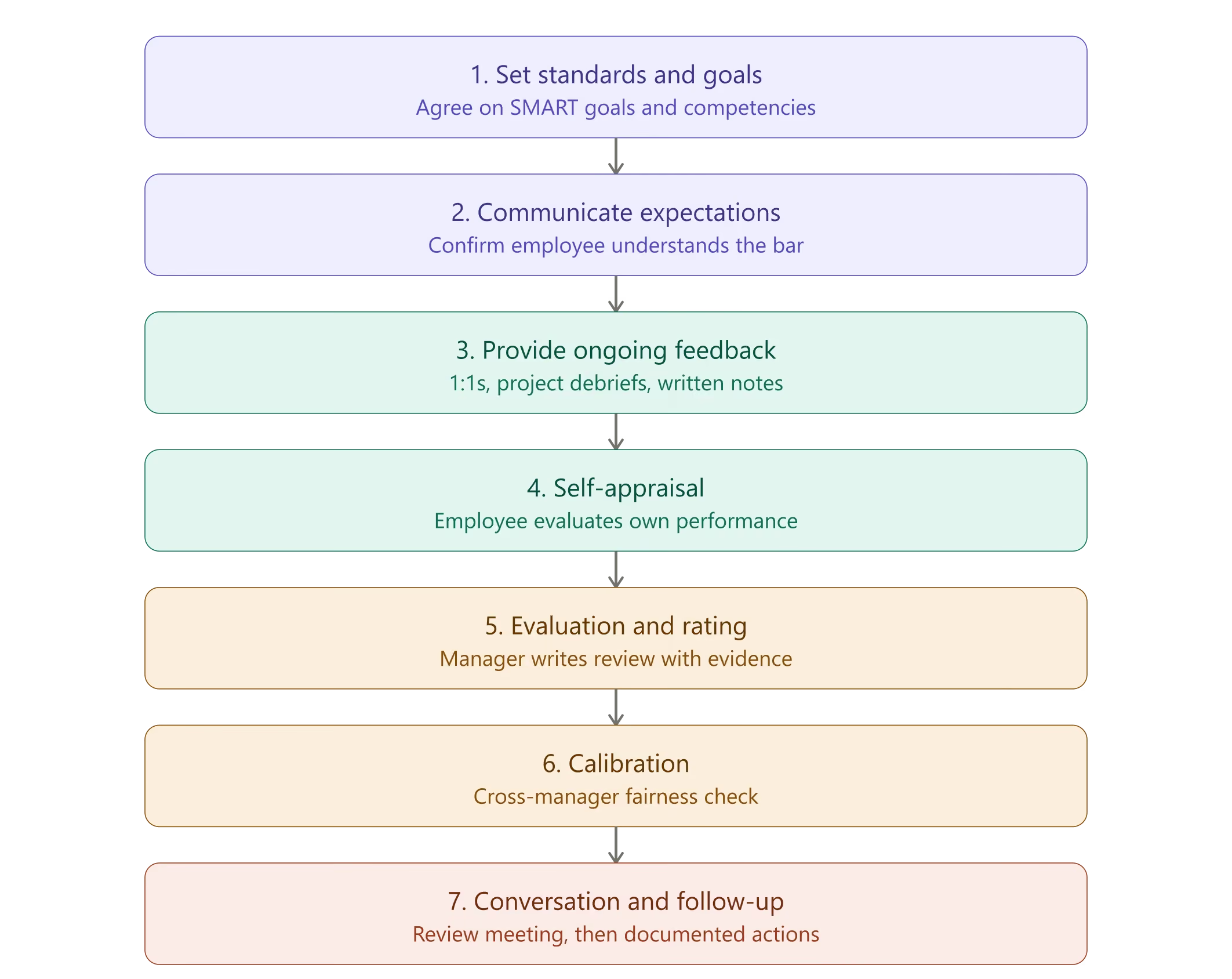
Step 1: Set performance standards and goals
At the start of the period, the manager and employee agree on what good performance looks like. This includes:
- The goals for the period, typically using SMART or OKR formats.
- The competencies or behaviours the employee will be evaluated against.
- The weighting between goals (the "what") and behaviours (the "how").
If standards aren't set clearly here, every later step gets harder. As HRBP, push managers to actually write goals down and share them with the employee. "We discussed it" is not a goal-setting record.
Step 2: Communicate expectations
The employee should leave the goal-setting conversation able to answer three questions: what am I being measured on, how will I be rated, and what does "exceeds expectations" actually look like for someone in my role?
If the answers to those three questions live only in the manager's head, the appraisal at the end of the year will be a negotiation, not an evaluation.
Step 3: Provide ongoing feedback
This is where most appraisal systems quietly fail. Standards are set in January, the next real conversation happens in November, and by then the manager remembers the last six weeks and has forgotten the first ten months. Document feedback throughout the year through 1:1 notes, project debriefs, and recorded coaching conversations. As HRBP, you can make this happen by giving managers a simple template and a recurring nudge, not by mandating another tool.
Step 4: Self-appraisal
A few weeks before the formal review, the employee completes a self-assessment using the same framework the manager will use. This gives the employee voice in the process and surfaces any gaps between how the employee and manager see the same work.
Step 5: Evaluation and rating
The manager reviews the goals, feedback notes, self-appraisal, peer input (if applicable), and any other evidence, and writes the formal evaluation. This produces a rating, narrative comments, and a recommendation on development, compensation, and career actions.
Step 6: Calibration
Before ratings are finalised, managers across a team or function meet to compare ratings and check that "exceeds expectations" means roughly the same thing across managers. This is the single most important fairness step in the whole cycle, and the one most often skipped or rushed. Without calibration, employees with strict managers get worse ratings than equivalent performers with lenient ones.
Step 7: The appraisal conversation
The manager sits down with the employee and walks through the evaluation. The conversation should cover what went well, where the gaps were, the rating, the supporting evidence, and the plan for the next cycle. The employee signs to acknowledge receipt (not necessarily agreement), and the document is filed.
A good conversation takes 45–90 minutes. If it is shorter, something is being skipped. If it is longer, something is being negotiated that should have been settled in calibration.
Step 8 (often forgotten): The follow-up
The appraisal output should produce concrete actions: a development plan, a salary letter, a promotion recommendation, or a Performance Improvement Plan. Each of those has its own follow-up. An appraisal that ends at the review meeting and produces no documented next step is just an annual conversation, not a performance management process.
Performance appraisal biases (and how to reduce them)
Appraisals are subjective by nature, and human raters bring predictable biases to subjective judgments. Knowing the patterns is half the battle.
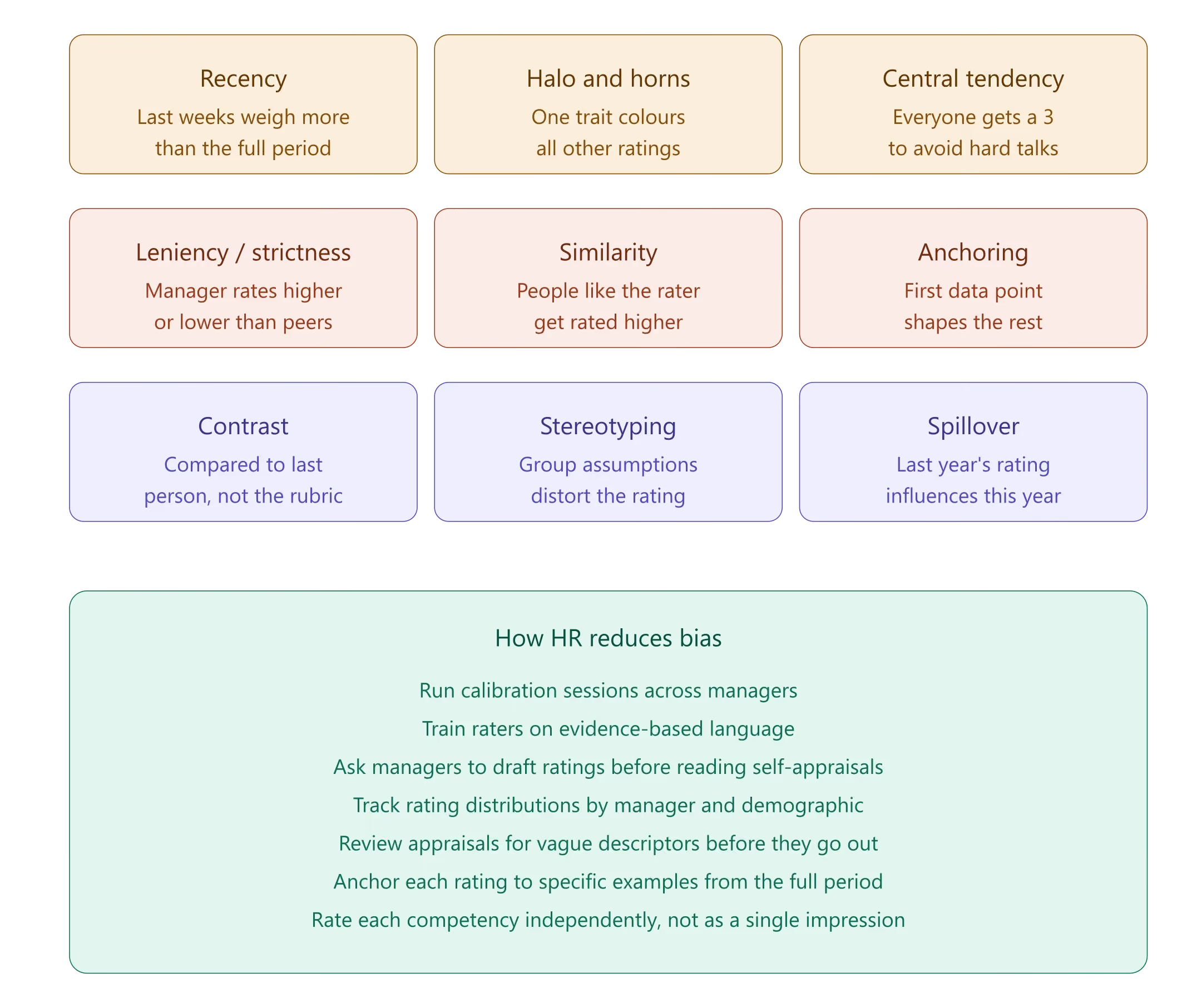
Recency bias. The manager weights the last few weeks more heavily than the rest of the period. The employee who closed a big deal in November gets a different rating from the one who closed it in February. Reduce it by: Asking managers to review their 1:1 notes and project records from the full period before drafting the rating.
Halo and horns effect. A strong impression in one area (or one weakness) bleeds into the rating on unrelated areas. The employee who is great at presenting is also rated high on technical depth, even when the evidence doesn't support it. Reduce it by: Rating each competency independently with specific evidence, not as a block.
Central tendency. The manager rates everyone in the middle of the scale to avoid difficult conversations. Useful for nobody. Reduce it by: Calibration sessions that ask managers to defend each rating with evidence.
Leniency and strictness bias. Some managers consistently rate higher than peers, others consistently rate lower. The employee's outcome depends as much on which manager they have as on what they did. Reduce it by: Calibration, and tracking rating distributions by manager over time.
Similarity bias. Managers rate employees who remind them of themselves more favourably. This is one of the larger drivers of demographic disparities in ratings. Reduce it by: Rater training, blind calibration where feasible, and tracking rating distributions by gender, ethnicity, and other categories.
Anchoring bias. The first piece of evidence a manager considers shapes how the rest is interpreted. If they start with the self-appraisal, the manager rating tends to drift towards it. Reduce it by: Asking managers to draft their initial rating before reading the self-appraisal.
Contrast effect. The manager rates an employee against the previous employee they reviewed instead of against the standard. The first person reviewed sets the bar for everyone after. Reduce it by: Rating each employee against the rubric, not against the last one reviewed.
Stereotyping. Demographic, cultural, or background assumptions distort the rating. Often unconscious. Reduce it by: Rater training, evidence-based language in narrative comments (HR can flag vague descriptors like "abrasive," "soft-spoken," or "not executive presence" during review).
Spillover effect. Last year's rating influences this year's rating, regardless of current performance. Reduce it by: Rating against the current period only, with current period evidence.
A practical HRBP move: build a one-page bias checklist for managers, attach it to the appraisal template, and review a sample of completed appraisals for vague language before they're shared with employees.
What goes inside a performance appraisal document
A defensible appraisal document contains the following:
- Employee and manager identification, role, period under review.
- The goals or objectives set at the start of the period, with results.
- Competency or behaviour ratings against the framework, with brief evidence for each.
- Narrative comments covering strengths, areas of development, and key contributions.
- An overall rating, where the system uses one.
- A development plan for the next period: training, stretch assignments, coaching.
- Actions resulting from the review: salary recommendation, promotion recommendation, PIP, etc.
- Signatures from manager, employee, and (in many companies) the next-level manager and HR.
Avoid vague language. "Great team player" tells you nothing. "Stepped in to lead the Q3 onboarding redesign when the project owner was on leave, delivered the new flow on time with no slippage on her own deliverables" tells you what actually happened.
How frequently should performance appraisals happen?
Annual reviews are still the most common format, but the trend has been towards shorter cycles. The right cadence depends on the work:
- Annual — Traditional, used in most large established organisations. Pairs with a mid-year check-in.
- Half-yearly — A reasonable middle ground.
- Quarterly — Common in tech and high-growth companies, often paired with OKRs.
- Continuous / check-in based — Lightweight weekly or bi-weekly 1:1s with a lighter formal review once or twice a year.
The frequency matters less than the consistency. A monthly check-in that always happens is more useful than a quarterly review that gets pushed three times.
The HRBP's role in the appraisal cycle
As an HRBP, the appraisal cycle is the most complex process you will run, and the one where business leaders judge HR most visibly. Here is what your job actually looks like at each phase.
Before the cycle starts
- Pressure-test the framework. Are the rating scales clear? Do the competencies match the actual work? Is there a process for resolving manager-employee rating disagreements?
- Train the managers. Many of them have never been formally trained on giving feedback, writing a review, or running a calibration session. A two-hour workshop in October pays for itself in January.
- Communicate the timeline. Employees should know when self-appraisals are due, when manager reviews are written, when calibration happens, and when the conversation will take place.
During goal-setting
- Sample-check the goals. Pull a random set across your business unit and read them. Are they specific? Measurable? Aligned with the team plan? If half of them are vague, the appraisal at year-end will be vague too.
- Watch for goal-setting that is mostly defensive (the manager protecting themselves) rather than developmental.
During the period
- Keep performance management visible. Regular conversations with people leaders about their teams, watching for early signs of underperformance, and making sure feedback is happening between formal cycles.
- Be the early warning system. If a manager is heading into the appraisal cycle planning to give a "needs improvement" rating to someone who has heard nothing all year, that's a problem to surface in October, not in February when the conversation explodes.
During calibration
- Run the calibration session. Ask managers to defend their ratings with evidence. Watch the distribution. Flag the outliers (the manager whose entire team is exceeds expectations, or the one whose entire team is meets).
- Watch for demographic patterns. Are women rated lower on "executive presence" than men with the same outputs? Are certain teams systematically rated below others? Calibration is the right moment to surface these.
- Document the calibration decisions. If a rating changes during calibration, note why.
During the conversation
- Be available to managers in the days before. The "how do I have this conversation?" question gets asked a lot.
- Sit in on the highest-stakes conversations: terminations dressed as appraisals, conversations with employees on protected leave, or any conversation where the manager has been struggling with the employee for a long time.
After the cycle
- Run a retrospective. What did employees say in the post-cycle survey? Where did calibration sessions take longer than expected? Which managers wrote the strongest reviews and which wrote the weakest? Use this to improve next cycle.
- Follow through on the outputs. Salary letters delivered on time, development plans actually started, PIPs initiated where the appraisal said they would be. The appraisal cycle ends not at the conversation but when the actions land.
Common mistakes HRBPs make in appraisal cycles
Treating it as a paperwork exercise. The forms are the smallest part of the work. Calibration, manager coaching, and follow-through are where the real value sits.
Skipping calibration. This is the single biggest fairness lever you have. Skipping it because the cycle is running late is the worst time-saving decision in HR.
Letting managers write whatever they want. "Great attitude" and "needs to be more proactive" are not appraisals. Read drafts before they go to employees and push back on vague language.
Forgetting that the appraisal is documentation. Every word in a written appraisal can show up later in a grievance, a wrongful termination claim, or a discrimination case. Vague, sugar-coated reviews are not just unhelpful for the employee; they are a legal liability for the company.
Compressing pay and development into one conversation. When pay is on the table, employees stop hearing development feedback. Where possible, separate the conversations by a week or two.
Letting recency dominate. If managers are drafting reviews from memory in January, you will get a January review. Build the habit of mid-year notes earlier in the year.
Not following up on outputs. A development plan that nobody opens after the meeting is worth nothing. A PIP that is recommended but never drafted is worth less than nothing. Track the actions to closure.
Frequently asked questions
What is the main purpose of a performance appraisal? To assess employee performance against pre-set standards and use the results for feedback, development, compensation, and career decisions. The mix of those four purposes varies by company.
What is the difference between performance appraisal and performance management? Performance appraisal is a periodic evaluation event. Performance management is the continuous system of goal-setting, feedback, coaching, and review of which the appraisal is one part.
Who conducts a performance appraisal? The employee's direct manager is the primary evaluator in most systems. Peers, direct reports, clients, and the employee themselves may provide input, depending on the method.
How often should performance appraisals be conducted? Annually is still the most common, with mid-year check-ins. Many organisations have moved to quarterly cycles or continuous check-ins paired with a lighter annual review. Cadence matters less than consistency.
What are the most common biases in performance appraisal? Recency, halo and horns, central tendency, leniency or strictness, similarity, anchoring, contrast, stereotyping, and spillover from previous cycles. Calibration sessions and rater training are the main mitigations.
Can an employee disagree with their performance appraisal? Yes. Most companies have a written response or appeal process. The employee's signature on the appraisal confirms receipt, not agreement. If the employee disagrees, document the disagreement, hear them out, and decide whether the rating should be revisited.
What happens after a performance appraisal? Depending on the outcome, the employee may receive a salary increase or bonus, be considered for promotion, enter a development plan, or in cases of sustained underperformance, be placed on a Performance Improvement Plan (PIP).
Are performance appraisals legally required? No, in most jurisdictions there is no legal requirement to run appraisals. However, performance documentation is heavily relied on in wrongful termination and discrimination cases. Companies that terminate without a documented performance record face much higher legal risk.
Should performance appraisals be tied to pay? This is one of the longest-running debates in HR. Tying them tightly together makes the appraisal feel high-stakes and reduces honesty in the development conversation. Decoupling them entirely is hard to operationalise. Most companies land somewhere in between, with the rating informing pay but not mechanically determining it.
Final thoughts
A performance appraisal cycle done well is one of the most useful things HR delivers. It tells employees where they stand, helps managers run their teams better, surfaces talent and underperformance early, creates a paper record that protects the company, and produces fair pay and promotion decisions.
A cycle done poorly is one of the most damaging. It rewards the wrong people, demoralises the right ones, exposes the company to legal claims, and leaves managers and employees both feeling that the whole thing was theatre.
The difference between the two is mostly invisible to the business. Calibration, rater training, evidence-based writing, follow-through on actions — these are the levers. None of them shows up on a slide. All of them show up in trust, retention, and the quality of the talent decisions the company makes for the next twelve months.
That trust is built one cycle at a time, and the HRBP who runs the boring, unglamorous parts of the process well is the one whose business leaders will eventually start asking for advice instead of approvals.